Framingham Wood Flooring brings more than 20 years of wood-flooring experience to West Roxbury, where we sand, refinish, repair and install hardwood for owners who plan to keep living in the house they are improving. The floors we meet here have usually worked hard for a long time: traffic lanes worn dull down a hallway, water stains near a sink, pet urine stains by a back door, or hardwood waiting under carpet that went down decades ago.
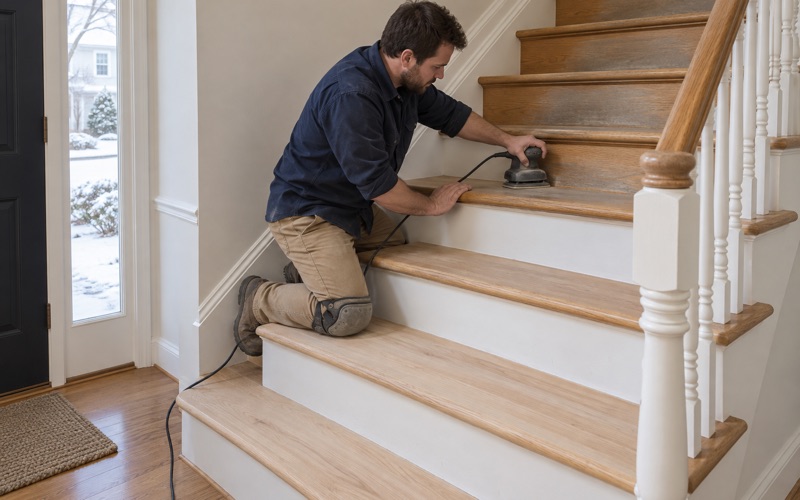
Our first visit is about the floor itself rather than a pitch. We read the boards with a moisture meter, look at how they were fastened, measure the wear layer on any engineered floor before promising a sanding, and ask when the house was built before sanding is even discussed. Stairs are priced by the tread and the riser, so a staircase never hides inside a square-foot number.
This page also answers a question worth raising early with a West Roxbury owner: whether a floor project can be paid for without a lump sum. The City of Boston runs a home repair program that lists flooring among the work it funds, and the homeowner applies to the city directly. Below is what the program says, who it is written for, and how we help an owner put a clear floor scope in front of that decision.
Paying for Floor Work Through Boston’s Home Repair Program

The Boston Home Center, part of the City of Boston, runs the Home Repair and Improvement Program for residents who own and live in their homes. It offers owner-occupants deferred, interest-free loans of up to $50,000, and the repairs it lists include flooring alongside kitchen or bathroom renovations and electrical upgrades. For an owner whose floors keep getting pushed behind a roof or a boiler, that listing is worth knowing about.
West Roxbury has been part of Boston since its annexation on January 5, 1874, after more than two decades as its own town. That history is the practical reason a Boston program reaches these streets at all, from the blocks around Bellevue Hill to the houses near the VFW Parkway. The neighborhood sits in Suffolk County, and its permits and inspections run through the City of Boston rather than a separate town hall.
How the loan is repaid
The city describes these loans as having no monthly payments and accruing no interest. The balance only becomes due when the owner sells the home, transfers ownership of the property, or refinances. One third of the loan is forgiven after 10 years of continuous owner-occupancy, which rewards exactly the kind of long ownership the program is built around.
For an owner planning to stay, that structure changes how a floor project gets weighed. A full sand and refinish of the main level, a board replacement where an old pipe leaked, or new solid hardwood in a room that has been carpeted for years can be judged against the rest of the house’s needs instead of against a single month’s budget.
The owner applies, not the floor company
The application runs between the homeowner and the Boston Home Center. We do not apply on anyone’s behalf, we do not administer the loan, and we are not a program contractor. Eligibility is decided by the city on income, assets and ownership, so no flooring company can tell a household how its application will turn out.
What we can do is make the floor portion of an owner’s plan easy to describe. Our written scope separates each room, lists square footage, marks where boards need replacing, prices stairs by the tread and riser, and names the finish. A scope like that is useful whatever the city decides, and it keeps an owner from guessing when explaining the floor work.
Looking for wood-flooring closer to Bellingham? See Bellingham Wood-Flooring.
Who the Program Is Written For: Houses, Two-Families and Small Condos
West Roxbury is a neighborhood where most households own the place they live in. The Boston Planning Department’s 2025 figures count 9,488 owner-occupied homes out of 13,917 occupied units, or 68.2 percent. Census estimates for ZIP code 02132, a close but imperfect proxy for the neighborhood, put 6,385 of 7,791 owner households, or 82.0 percent, in detached houses.
The program’s basic conditions are published plainly. An applicant must own and occupy a one- to four-family home in Boston, or a condo in an association of six units or fewer. Annual household income must be at or below 135 percent of area median income, and the household must be current on property taxes, mortgage and water bills.
Income, assets and cost sharing
The city also sets a limit of under $100,000 in financial assets, and homeowners 60 and older are exempt from that asset test. Households earning between 120 and 135 percent of area median income provide a 50/50 cost share on the work. Those are the rules as the city publishes them, and an owner should read the current version from the Boston Home Center before assuming where a household falls.
Two-family owners with a unit to rent
The one- to four-family language reaches past the detached house. In ZIP 02132, 643 owner households live in two-unit buildings, and an owner living in one unit of a two-family is the occupant the program describes. That owner usually has two sets of floors to think about: their own, and the rental unit above or below.
When we quote a two-family, the owner’s unit and the rental unit are separate line items. Rental floors have their own rhythm, since the gap between tenants is the natural window for a screen and recoat or a full sanding. Boston’s annual rental registration covers the rental side, while owner-occupied buildings of six or fewer units are exempt from the city’s five-year rental inspection, so tenant turnover sets the schedule.
Small condo associations
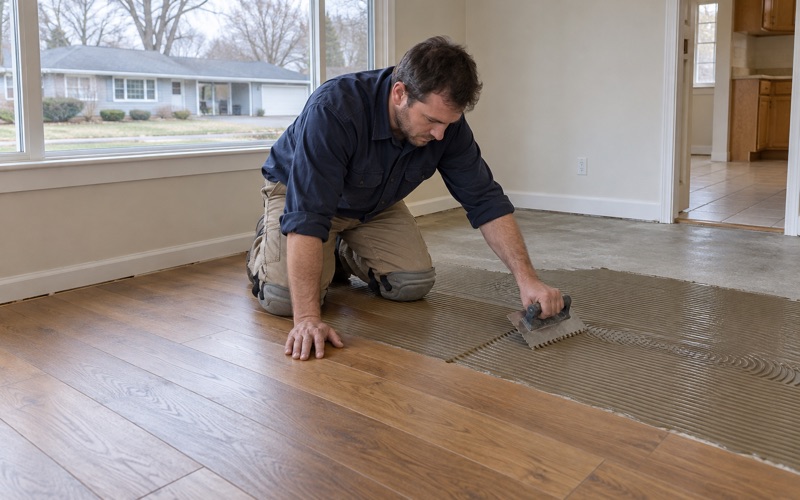
Condo owners are included when the association has six units or fewer. Who owns and maintains the floor in a condo depends on the association’s documents, and small buildings often have rules about underlayment, noise and work hours. We ask for those rules before recommending a floating installation or a glue-down installation in an upper unit, and our quotes make no sound-rating promises.
Floor Work in a Long-Held Detached House
A house that has been owned and lived in for a long stretch collects a familiar set of floor problems. Traffic lanes wear through the finish in front of the sink and down the hall, winter gaps open between boards when the heat runs dry for months, and small leaks from an ice maker line or a hot-water baseboard leave dark water stains nobody got around to fixing.
Refinishing before replacing
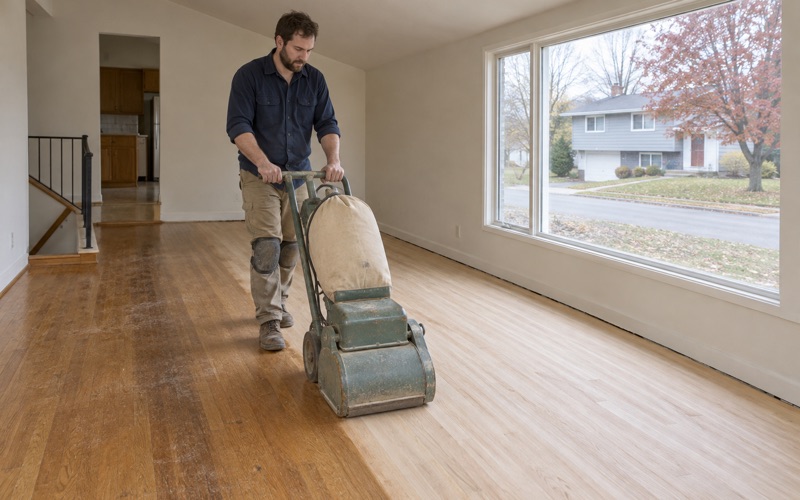
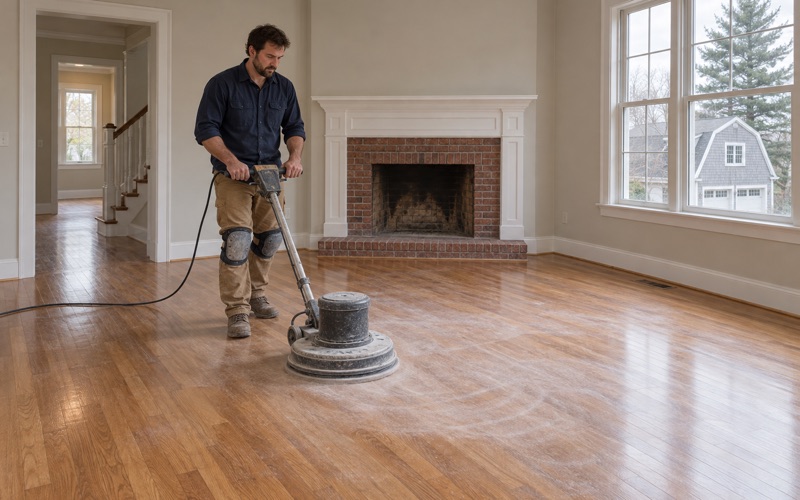
Most of these floors can be sanded rather than torn out. Solid hardwood in red oak, white oak or maple usually has sandings left in it, and a drum sander followed by an orbital sander, run through a careful grit sequence, takes out traffic lanes and shallow stains. We sand dustless, with a HEPA vacuum attached, which matters in an occupied house where the family is not moving out for the week.
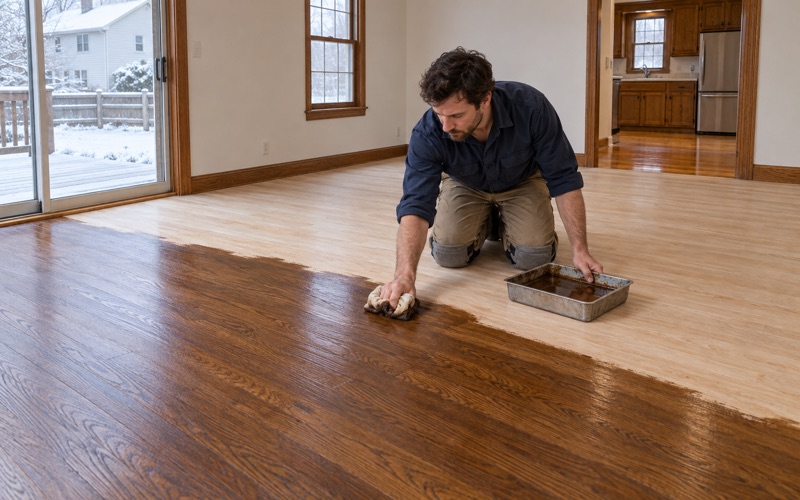
Where oak has turned orange or yellowed under an older oil-modified polyurethane, we lay out stain samples on the actual floor before anyone commits to a color. Water popping the grain before staining evens out the result on red oak, and a waterborne polyurethane or a hardwax oil can carry the floor to a natural or modern tone. Every finish we use fits the Massachusetts VOC limits for wood coatings, which are stricter than the federal ones.
Hardwood found under old carpet
When an owner pulls up wall-to-wall carpet and finds hardwood underneath, the prep matters more than the sanding. We remove the carpet pad, pull every carpet staple, take out the tack strip along the walls, and fill the tack-strip holes with wood filler before the first pass of the sander. Doing that cleanup first is what keeps staple scars from showing through a fresh finish.
Leaks, moisture and repairs
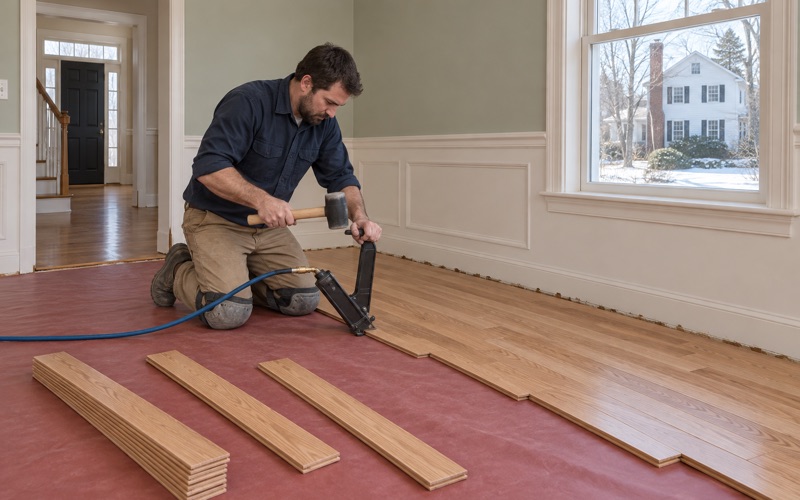
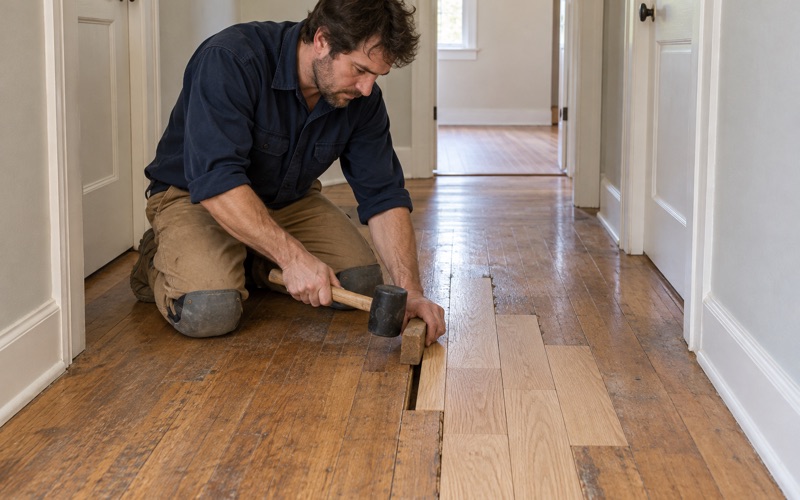
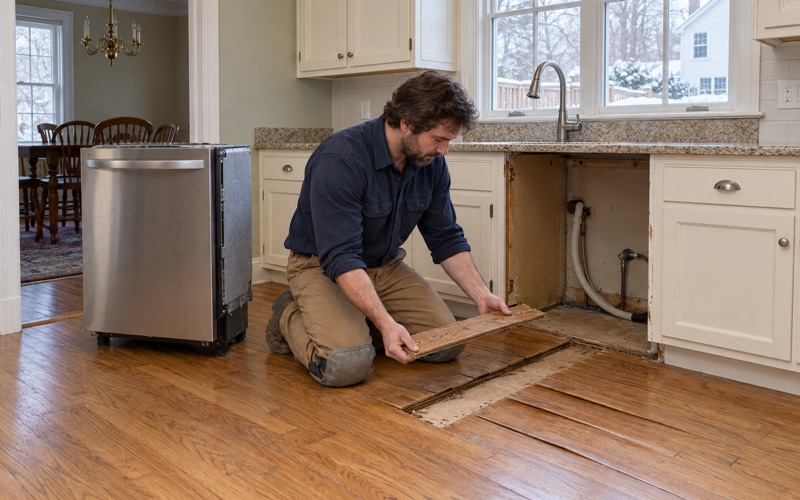
Cupping, crowning and buckling nearly always trace back to water. When a dishwasher, ice maker or baseboard pipe has leaked, we find the source, dry the boards and read them with a moisture meter before replacing anything. New tongue and groove boards are then tied in with a weave-in repair, and when the damage is part of an insurance claim, we document it room by room for the adjuster.
Build year and painted surfaces
Before sanding starts, we check the house’s build year and look for paint on thresholds, stair risers, baseboard and quarter round. Massachusetts runs its own lead-safe renovation rules for homes built before 1978, and census estimates for ZIP 02132 place 5,310 of 11,982 housing units in the built-1939-or-earlier bracket. That check decides how prep and dust control are handled.
Planning a Floor Project in West Roxbury
We suggest starting with the floor and settling the money second. A walk-through, measurements and a written scope tell an owner what the work actually is, whether that owner pays directly or looks into the Boston Home Center program. Permit questions for a specific scope belong with the City of Boston Inspectional Services Department, and we point owners there rather than guessing at an answer.
Choosing the right wood
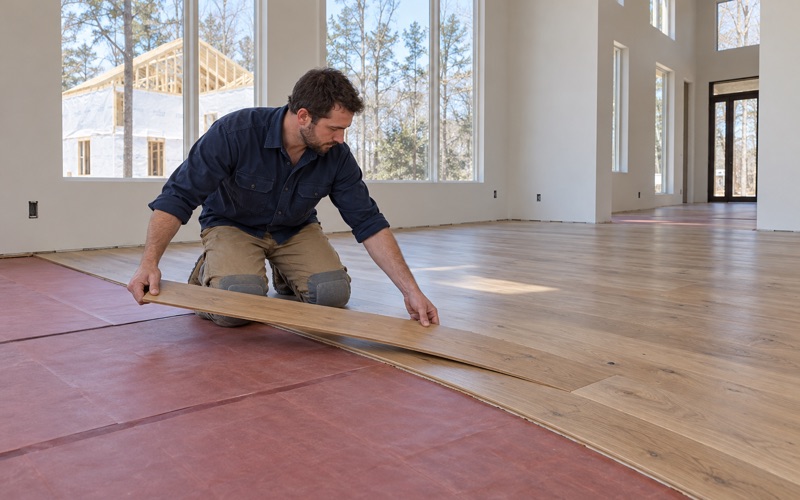
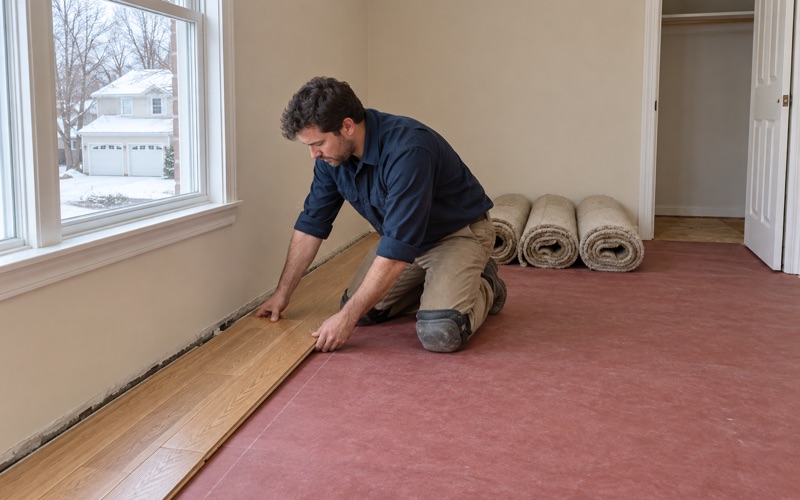
For new floors, the choice usually comes down to solid hardwood or an engineered floor with a plywood core. Wide plank white oak, rift and quartersawn boards, select grade for a quiet look or character grade for knots and color variation are all on the table, and Janka hardness helps sort species for a busy kitchen. Prefinished boards shorten the job, while site-finished floors let us match sheen level across rooms.
Basements get more caution. Any below-grade space, walkouts included, is measured against the NWFA below-grade rule before we recommend wood at all, and that often points to an engineered floor over a vapor retarder rather than solid boards. Stair treads, stair nosing and reducers at each threshold are planned with the main floor so heights line up.
Timing around the seasons
West Roxbury falls in National Weather Service forecast zone MAZ015, Suffolk, and like the rest of eastern Massachusetts it swings between humid summers and dry, heated winters. We run a relative humidity test, let new boards go through acclimation, and leave a proper expansion gap at the walls, so the floor moves with the seasons instead of cupping in August or gapping in February.
When the scope is settled, an owner knows the rooms, the materials, the finish and the price before any work begins. If that scope goes to the city as part of a program application, it describes the floor honestly. If it does not, it is simply a clear plan for a floor meant to last as long as the owner stays.
- 20+ Years on Wood Floors
- Free Written Estimates
- Lead-Safe Work Practices