Framingham Wood Flooring brings more than 20 years of work to wood-flooring in Waltham, and a large share of the floors we are called to here belong to rental units rather than to the people who live on them. That shapes the job from the first phone call. The person paying is often an owner or property manager, the person living on the floor is a tenant, and the schedule has to fit a lease rather than a vacation.
We refinish, repair and install solid hardwood and engineered floors, and we handle stairs as their own line item, priced by the tread and riser instead of being buried in a square-foot number. When a landlord needs a unit ready between one lease and the next, we plan the sanding, coats and cure time around the move-out and move-in dates so the apartment is not sitting empty longer than it has to.
Owners who live in their own Waltham homes get the same care. We look at the whole floor first: the species, the wear pattern, any cupping or board gapping, and what sits underneath. Then we explain what a sanding can fix, what calls for board replacement, and what each finish option costs in time and dollars before any machine comes off the truck.
Rental Floors Under Waltham’s Housing Code Enforcement
Rented homes are not a side market in this city. Of Waltham’s 25,498 occupied housing units, 12,828 are renter-occupied, which is 50.3 percent, according to the Census Bureau’s 2024 five-year American Community Survey. Put plainly, about half the households here rent. That means floor decisions are often made by someone who never walks across the boards in socks, and the condition of those boards is part of a landlord’s obligations.
How the city inspects rental housing
The City of Waltham Health Department runs a Code Enforcement Program through its Housing Services, working under the State Sanitary Code, Chapter II, cited as 105 CMR 410.000. The department states that inspections happen either as part of its routine, ongoing program or as the result of an occupant complaint. For a property owner, that second path matters most: a tenant’s call about a problem floor can bring an inspector to the unit.
Floors and staircases on the structural list
The program lists the structural elements its inspectors look at, and both floors and staircases are on it, alongside foundations, ceilings, walls, roofs, doors, porches, windows and chimneys. The list names the floor as an element; it does not publish a finish or appearance standard for wood. What it signals is that a floor or stair in poor repair is a housing condition the city can look at, not only a cosmetic complaint.
For us, that reframes a lot of ordinary wood problems. A loose stair tread, a split nosing, boards lifting after a leak, or a soft spot where the subfloor has let go are defects we fix as structural repairs first and appearance second. We cannot tell a landlord how an inspector will rule, and refinishing promises no particular outcome, but we can make the wood itself sound.
Responding after an occupant complaint
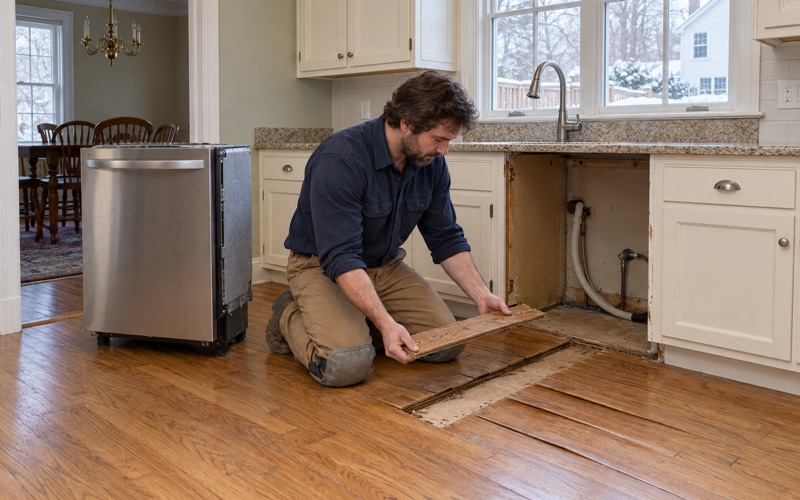
When a landlord calls us after a complaint, we start with the cause rather than the symptom. Boards that have cupped or crowned near a kitchen often point to a dishwasher or ice maker line, and buckling along an outside wall can trace back to a hot-water baseboard pipe. We find the source, dry the boards, and read them with a moisture meter before we decide whether anything needs replacing.
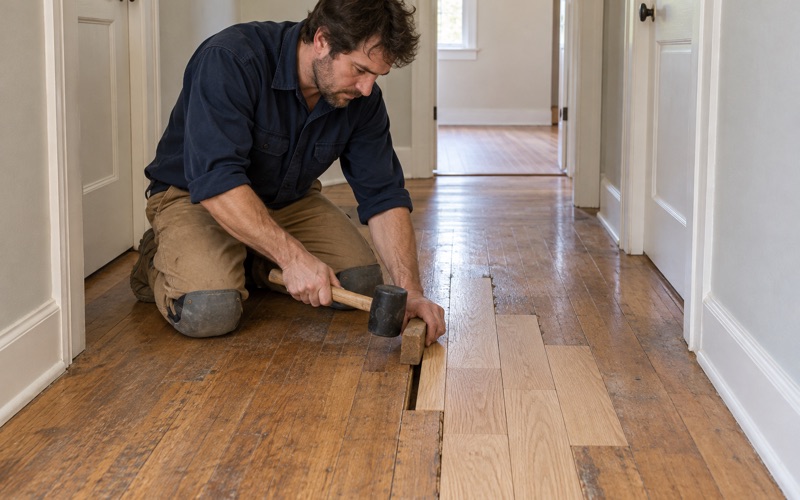
If the floor was damaged by water and an insurance claim is involved, we document the damage room by room so the adjuster has a clear record. The repair is then a weave-in of matching boards, sanded and finished to blend with the rest of the room, rather than a patch that announces itself to the next tenant.
Looking for wood-flooring closer to Milford? See Wood-Flooring in Milford.
Apartment Buildings of Five or More Units
Most of Waltham’s renters live in larger buildings. Of the city’s 12,828 renter households, 6,906, or 53.8 percent, rent in buildings with five or more units. The survey breaks that down further: 1,932 households in buildings of five to nine units, 1,889 in ten to nineteen, 901 in twenty to forty-nine, and 2,184 in buildings of fifty units or more. Floor work in those buildings is a different job from a single-family refinish.
Working around neighbors and shared halls
In an apartment building, the units above, below and beside the one we are working in are still occupied. We use dustless sanding with HEPA vacuum collection wherever the floor allows it, keep equipment staged inside the unit instead of the common hallway, and choose finishes with the whole building in mind. Waterborne polyurethane carries less odor than an oil-modified product, which neighbors sharing a ventilation path tend to appreciate.
We also keep to the Massachusetts VOC limits for wood coatings under 310 CMR 7.25, which are stricter than the federal ones. In a building where several households share walls and air, a lower-emission finish is not a luxury. It is part of doing the job without generating complaints of a different kind while the floor cures.
Access is part of the plan as well. We coordinate elevator use, parking and hallway protection with the manager ahead of time, and we give the occupants of the unit a clear window for when a room will be off limits and when it can take furniture again. Waterborne finishes usually allow light foot traffic sooner than oil-modified ones, though a full cure takes longer than the first day.
Condominium rules and turnaround schedules
Some buildings of five or more units are condominiums rather than single-owner rentals. Under M.G.L. c.183A, the association’s governing documents can set rules for flooring, underlayment and work hours, and we ask to see them before recommending a product. An owner who swaps carpet for hardwood without reading them can end up redoing the job, so we read first and choose accordingly.
For property managers turning over several units a year, we keep the process repeatable. The same species, stain and sheen level from one unit to the next makes future repairs easier, and a screen and recoat between tenants can extend a finish that is worn in the traffic lanes but not through to bare wood. Full sanding is saved for floors with deep scratches, pet urine stains or dark water stains.
Three- and Four-Unit Rentals
Waltham’s smaller rental buildings are a sizable piece of the picture too. The survey counts 2,313 renter households in buildings of three or four units, plus 1,815 in two-unit buildings. It also counts 754 owner households in three- and four-unit buildings, so some of these landlords live on site, one floor away from the work. Their floors tend to show every repair and cover-up a building collects over the decades.
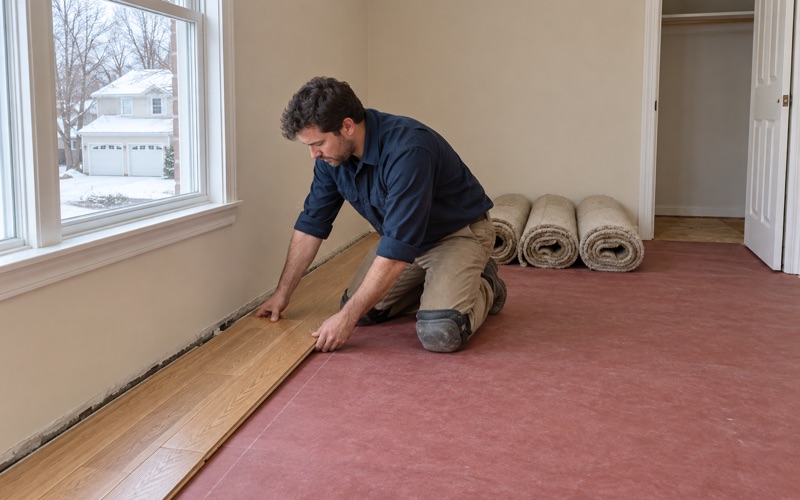
Old oak under new carpet
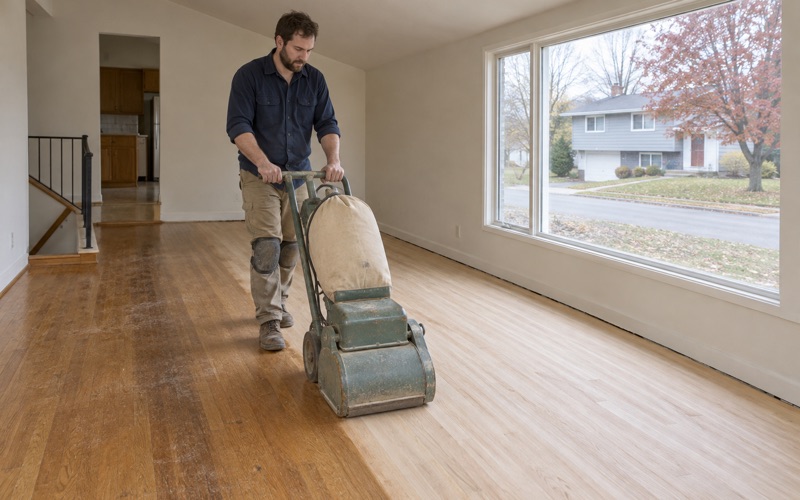
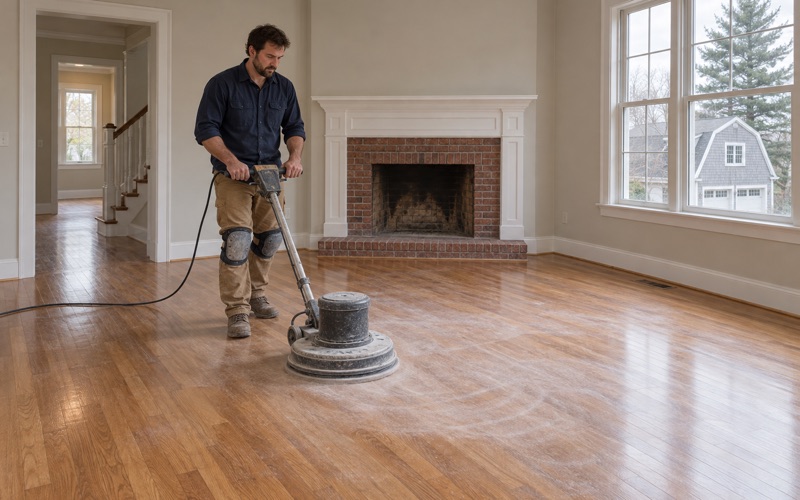
A common call from these owners starts with carpet coming up between tenants and oak showing underneath. We clear the carpet pad, the tack strip and every carpet staple before any sanding, and we fill the tack-strip holes along the walls so they do not print through the finish. Red oak and white oak both respond well to a full grit sequence on a drum sander followed by an orbital pass along the edges.
Pulling up carpet sometimes reveals more than stains. Small round exit holes and fine powder can point to powderpost beetles, and soft, hollowed wood near a damp sill can point to carpenter ants. When we see either, we stop and tell the owner, because boards and subfloor with active damage need a pest professional and structural repair before any refinish is worth the money.
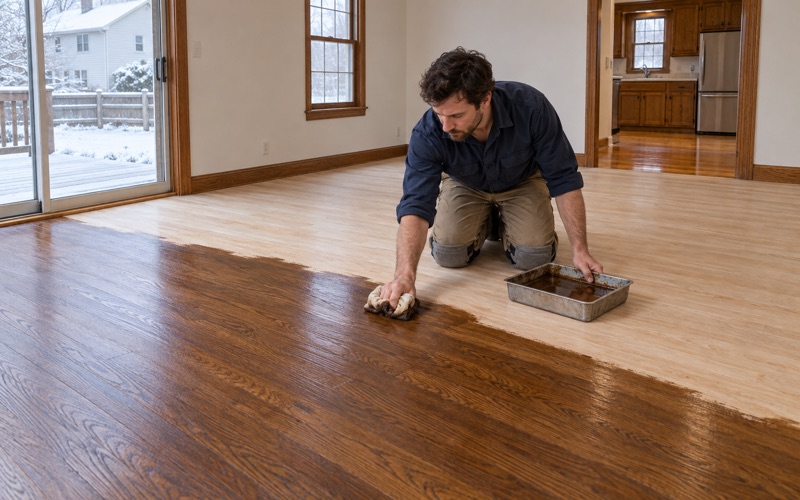
Oak that has turned orange or yellow under an old finish is another frequent request. We lay down stain samples on the actual floor, in the owner’s own light, so the choice between a natural tone and a modern gray or brown is made on the boards that will carry it. Water popping before staining helps the color take evenly on oak that has been sanded smooth.
Stairs, halls and lead-era surfaces
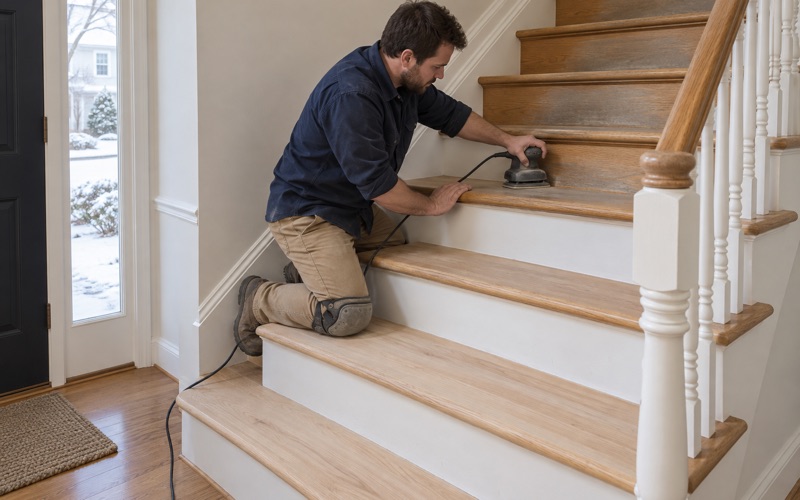
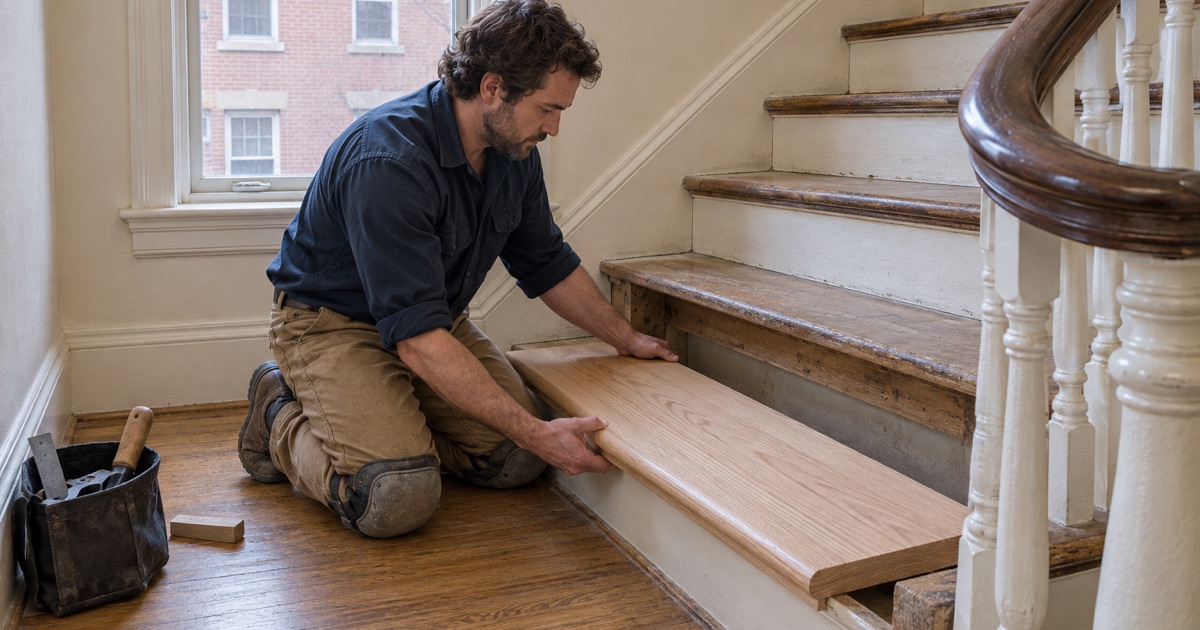
The shared stairs in a three- or four-unit building take more wear than any single room. We quote stair treads and risers by the piece, repair or replace worn stair nosing, and treat the stair as its own project instead of an afterthought. In a building this size, a tread that is loose or cracked is worth addressing before it turns into a tenant’s complaint.
Before sanding, we check the building’s age and look for painted surfaces on risers, skirt boards and old floor borders. Massachusetts runs its own lead-safe renovation rules for homes built before 1978, including the Massachusetts Lead Law and 454 CMR 22.00, and the federal TSCA Title VI rules sit alongside them. Knowing whether paint is in the work area changes how the job is set up and who performs which step.
Planning a Floor Project in Waltham
Waltham sits in National Weather Service forecast zone MAZ014, Southeast Middlesex, and its buildings move between humid summers and dry, heated winters like the rest of the region. Wood moves with them. Winter gaps between solid boards are normal in a heated building and usually close again in summer, so we take a relative humidity test before installation and let new wood acclimate instead of chasing seasonal movement with wood filler.
Choosing solid or engineered
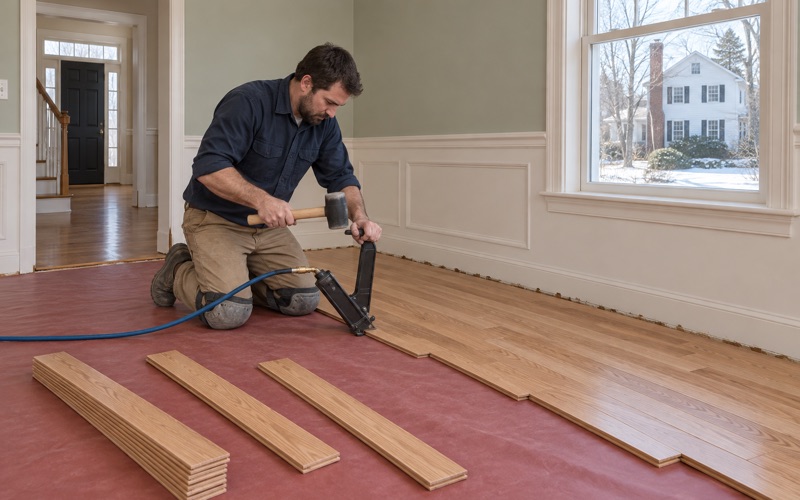
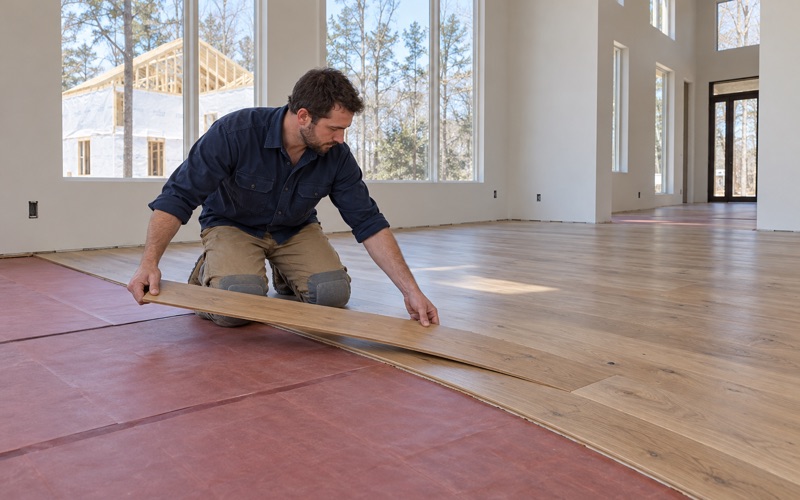
Solid hardwood can be sanded many times over its life, which suits a rental that will be refinished between tenants for decades. Engineered flooring, with a plywood core and a wear layer on top, is the more stable choice over radiant heat or where moisture is a concern below grade. Before we promise a sanding on an engineered floor, we measure the wear layer, because some products have too little to sand at all.
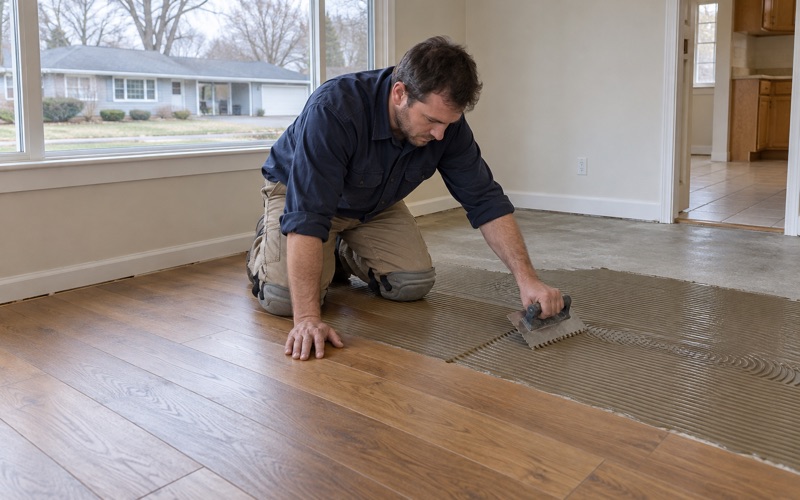
Basements get the NWFA below-grade rule applied before we recommend any wood, walkouts included. If the space fails that test, we say so and suggest a floating installation of a suitable engineered product, or no wood at all, rather than install a floor that will cup within a season.
Older buildings and city offices
If a project involves more than the floor, such as taking down part of an older structure, Waltham’s Historical Commission advises the Building Inspector on demolition permit applications under Chapter 23 of the General Ordinances. A building found preferably preserved is subject to a twelve-month demolition delay, a period the City Council set in 2011. A refinish involves no demolition, but owners of older buildings should know the rule exists.
For the flooring itself, we point owners to the City of Waltham building department with any question about what the city wants on file for their particular job, since that answer depends on the scope. Then we set a schedule that fits the lease, the tenants and the building, and we walk the finished floor with the owner before we leave.
- 20+ Years on Wood Floors
- Free Written Estimates
- Lead-Safe Work Practices