
Framingham Wood Flooring helps homeowners replace carpet with hardwood in Framingham, MA, serving surrounding cities including Cochituate, Marlborough, Hopkinton, Wellesley and Maynard. Across more than 20 years on wood floors, we have pulled up a great deal of carpet, and we start every job the same way: by checking what is underneath before anyone decides what to buy.
In many houses built from the 1950s through the 1970s, the answer is oak strip flooring that was covered with wall-to-wall carpet decades ago and has been protected ever since. That floor can often be refinished for far less than new flooring costs. In other rooms, the carpet sits on plywood, particleboard or a concrete slab, and new hardwood is the answer. Either way, knowing first keeps the plan and the price honest.
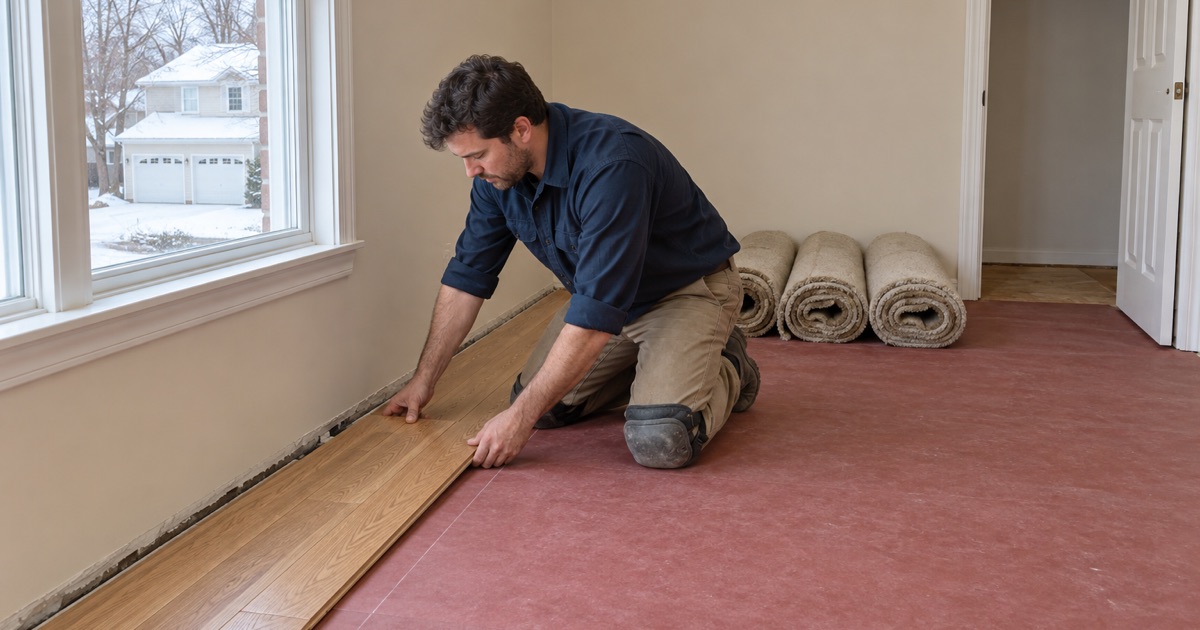
The work between carpet and finished wood matters as much as the choice of floor. Pad, tack strip and hundreds of staples have to come out cleanly, holes have to be filled, and the subfloor has to be sound. Those steps are easy to rush, and rushing them is what leaves a new floor with gouges, squeaks or visible patches around the edges of every room.
Checking What Is Under the Carpet
Oak Strip Hiding Underneath
The most common find under older carpet is narrow red oak strip flooring, often in good condition because the carpet protected it. We pull back the carpet in a closet or at a register to check the species, the condition of the finish, and any stains or damage. If the oak runs through several rooms, it can usually be refinished as one continuous floor.
Plywood or Particleboard Only
Some rooms, especially additions, finished attics and houses built later, have carpet laid directly over plywood or particleboard. Those rooms need new hardwood installed over a suitable subfloor. Particleboard in particular does not hold flooring fasteners well, so we may recommend a plywood overlay before new wood goes down.
Concrete Slab Rooms
Slab ranches and finished basements often have carpet laid straight onto concrete. Solid hardwood cannot be nailed there, so engineered hardwood glued down or floated over a proper vapor retarder is the usual replacement. We test the slab moisture first, and in basements we measure against the NWFA below-grade guidelines, walkouts included, before recommending any wood at all.
Removing Carpet the Right Way
Carpet, Pad, Tack Strip and Staples
We remove the carpet and pad, pull the tack strip from around the edges of each room, and remove every carpet staple left in the floor. It is tedious work, but staples left behind tear sanding belts and gouge the wood during refinishing. Tack-strip holes along the walls are filled with wood filler or, where the damage is worse, repaired with new boards.
Stuck Pad and Adhesive
Old foam pad can break down and stick to the floor, leaving a crumbly or sticky layer across the finish. We scrape it off before sanding, since leaving it for the sander to deal with clogs the paper and burns the floor. Where carpet was glued down, the adhesive has to be removed or the floor replaced, and we tell you which is realistic once we see it.
Older Homes and Painted Surfaces
In houses built before 1978, removing baseboard or shoe molding to lift carpet cleanly can disturb old paint. Massachusetts has its own lead-safe renovation rules for that housing. We check the build year and plan around painted trim before it is removed, so a carpet job does not turn into a lead dust problem.
Refinish the Oak or Install New Wood
Refinishing Uncovered Oak
Once the carpet is out and the floor is cleaned of pad and staples, uncovered oak is sanded to bare wood, repaired where needed and finished in the color you choose. Many owners are surprised by how good the floor looks, and it is often the least expensive way to get hardwood throughout a house.
New Solid Hardwood Over Plywood
Where there is no hardwood underneath, we install new solid hardwood over the plywood subfloor after checking it for flatness and squeaks. We acclimate the boards, read them with a moisture meter, and match them to any existing floors in adjoining rooms so the house reads as one floor.
Engineered Hardwood on Slabs and in Basements
For concrete slabs, including slabs with radiant heat, engineered hardwood rated for that use is installed as a glue-down or floating floor. In basements, the moisture readings decide whether wood is appropriate at all, and we will tell you if they say no.
Stairs, Hallways and Transitions
Carpeted Stairs
Stairs are often carpeted along with the rooms, and many have rough treads beneath. We either refinish the existing treads or fit new hardwood treads, risers and nosing, priced by the step so the cost is clear.
Matching Hallways and Bedrooms
When some rooms have oak under the carpet and others do not, we match new boards to the existing oak and weave them together at doorways. Sanding and finishing everything together gives one continuous color.
Door Heights and Transitions
Hardwood is usually thinner than carpet and pad, so doors may have a larger gap underneath after the change, and new floors may sit higher than adjoining tile. We plan thresholds and reducers so each transition is smooth and safe.
Condos and Sound Control
Association Rules on Hard Flooring
Many Massachusetts condo associations restrict hard flooring in their by-laws or require acoustic underlayment and board approval before carpet can be replaced. We read the rules and provide product specifications for approval before any carpet comes up, so you are not asked to remove a finished floor later.
Upper-floor units are where this matters most, because footsteps on hardwood carry into the unit below far more than on carpet. A sound-rated underlayment under engineered flooring, plus rugs in the main living areas, usually satisfies both the association and the neighbors downstairs. We schedule the loudest work during the hours the association allows.
- 20+ Years on Wood Floors
- Free Written Estimates
- Lead-Safe Work Practices