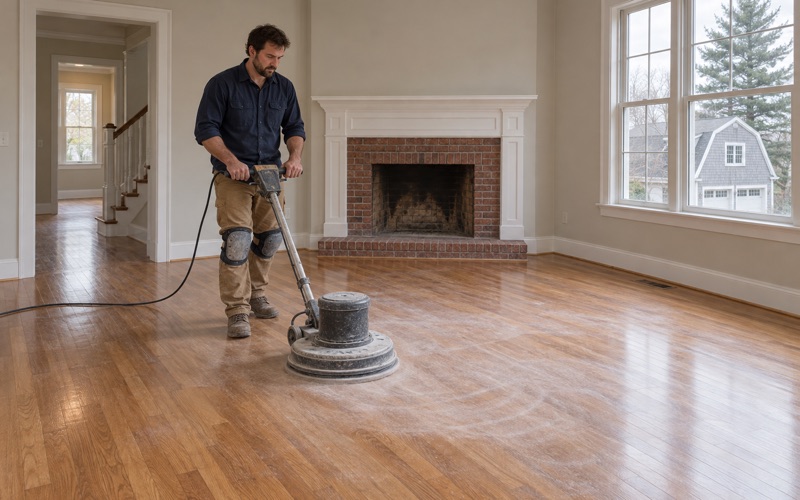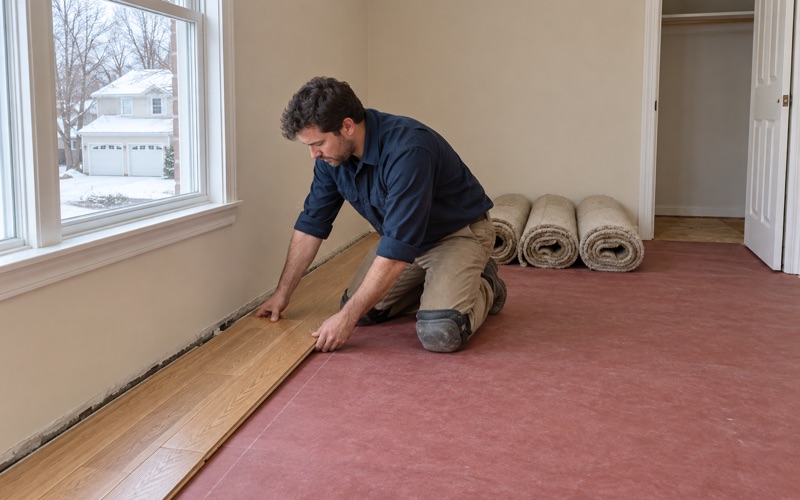
Framingham Wood Flooring brings more than 20 years of work to wood-flooring in Newton, and much of what we are asked to do there involves floors that already have a long history. Refinishing, board replacement, stair repair and new installation all begin the same way: finding out what is actually in the room, how many times it has been sanded, and what the house around it will tolerate.
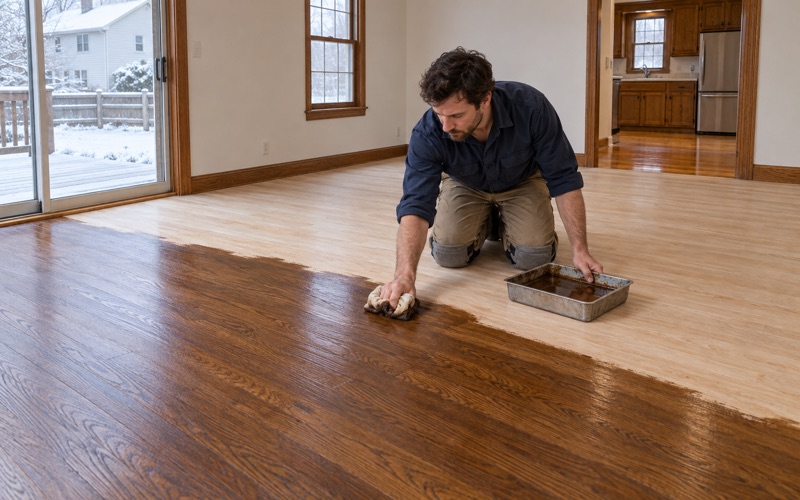
Our estimates are written for older floors. Oak pulled out from under wall-to-wall carpet has its pad, staples and tack-strip holes cleaned up before sanding, not discovered halfway through it, and if decades of finish have turned the oak orange or yellow, we lay color samples on your actual boards before anyone commits to a new tone.
A two-family house adds one more question to every job: who lives on the other side of the floor. We plan dust, noise, finish odor and drying time around that household as carefully as around yours, whether you own the building and live in one unit, rent out both, or are the tenant asking the landlord for a refinish.
Prewar Floors Across Newton’s Thirteen Villages
The Census Bureau’s 2024 five-year American Community Survey counts 33,959 housing units in Newton, and 16,583 of them, 48.8 percent, were built in 1939 or earlier. Add the 1940s and 1950s and the share built before 1960 reaches 67.0 percent. In practical terms, a Newton floor has often been through several owners, several finishes and at least one round of being covered up before we see it.
The city is a patchwork of thirteen villages: Auburndale, Chestnut Hill, Newton Centre, Newton Corner, Newton Highlands, Newton Lower Falls, Newton Upper Falls, Newtonville, Nonantum, Oak Hill, Thompsonville, Waban and West Newton. We work in all thirteen, and we do not guess a floor’s age from the village name. The build year of the specific house, checked before we quote, is what shapes the plan.
Newton is known as the Garden City and was one of North America’s earliest commuter suburbs, so many of its houses have been lived in and remodeled for a long time. Kitchens get moved, rooms get opened up and additions go on, and a single house can end up with floors of several ages meeting at its doorways, each needing to be read on its own terms.
Reading a Floor That Has Been Sanded Before
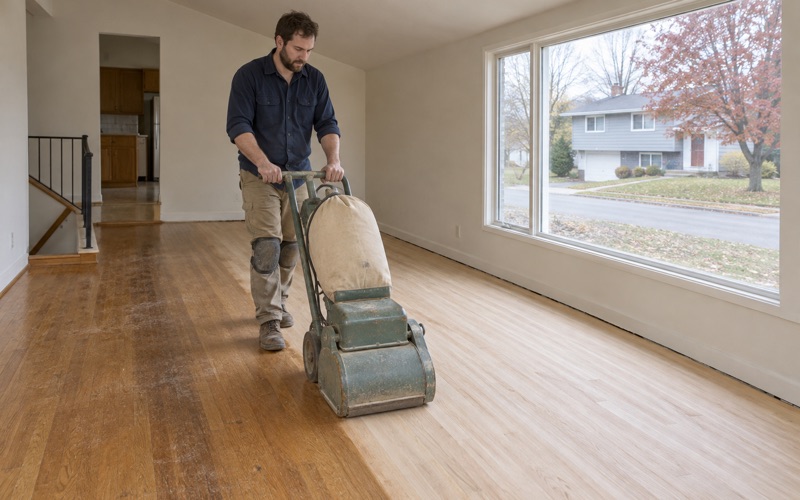
A prewar floor may already have been through several drum sandings, and every pass takes wood off the top of the tongue and groove. Before we promise a full sanding, we pull a floor register or check a threshold edge to see how much wood remains above the tongue. Where it is thin, a screen and recoat or a gentler grit sequence can be the better call.
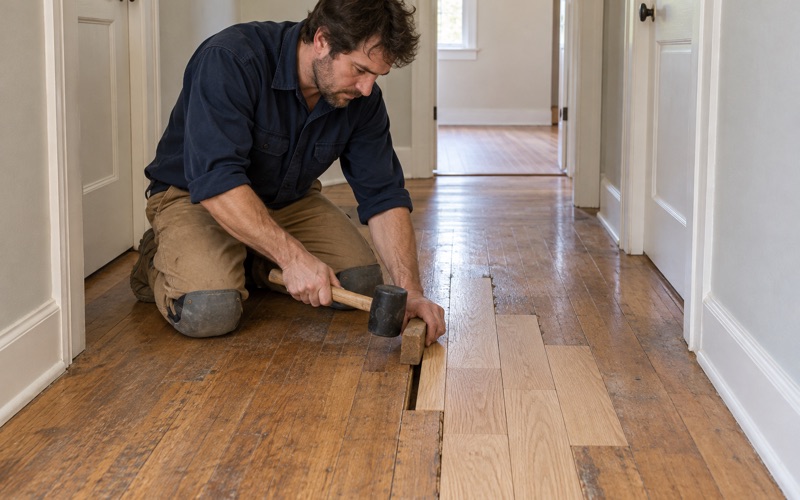
Old floors also carry old repairs. Patches in a different species, face-nailed boards by doorways, and filler that has cracked out of the joints all show up once the finish comes off. We plan weave-in repairs and board replacement into the estimate, so a refinish does not uncover a problem nobody priced.
Species and Construction We Do Not Assume
We will not tell you what is under your carpet before we have seen it. Red oak, white oak, maple and eastern white pine all turn up in older New England houses, and an addition or a kitchen remodel can bring in something else entirely. Identifying the species, the grade, and whether a room is solid hardwood or a later engineered product comes first, because it decides the stain, the finish and how hard we can sand.
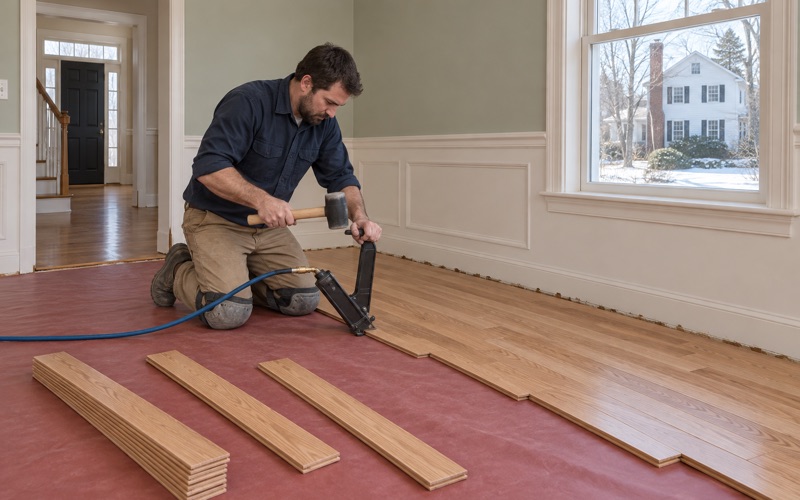
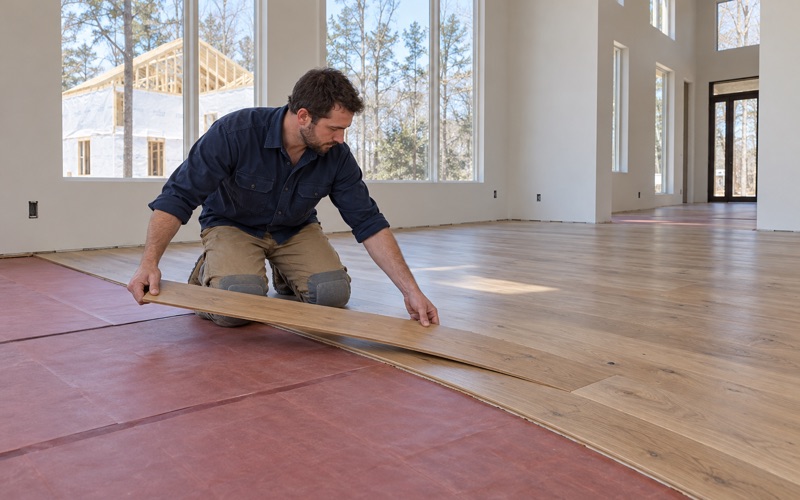
When a room needs new boards to meet an old floor, we match width, species and grade as closely as the stock allows, and we let the new wood acclimate in the house before it goes down. New solid hardwood is nailed with flooring cleats into the existing subfloor and, wherever the layout allows, woven into the old boards rather than butted against a reducer, so the seam fades after sanding.
Looking for wood-flooring closer to Upton? See Upton Wood-Flooring.
Two-Family Houses: One Unit at a Time
Two-unit buildings hold 5,277 of Newton’s housing units, 15.5 percent of the total, in the same Census survey. They matter even more on the rental side: 2,785 renter households live in two-unit buildings, 28.8 percent of Newton’s renters and the largest renter group of any building type. Overall, 30.0 percent of the city’s occupied units are rented.
That makes the two-family one of the settings we plan for most carefully. The owner may live in one unit with a tenant in the other, or both units may be rented, and work in one unit always reaches the people in the other. We talk through both households at the first visit, not on the morning the sanders arrive.
Noise, Dust and Finish Odor Between Units
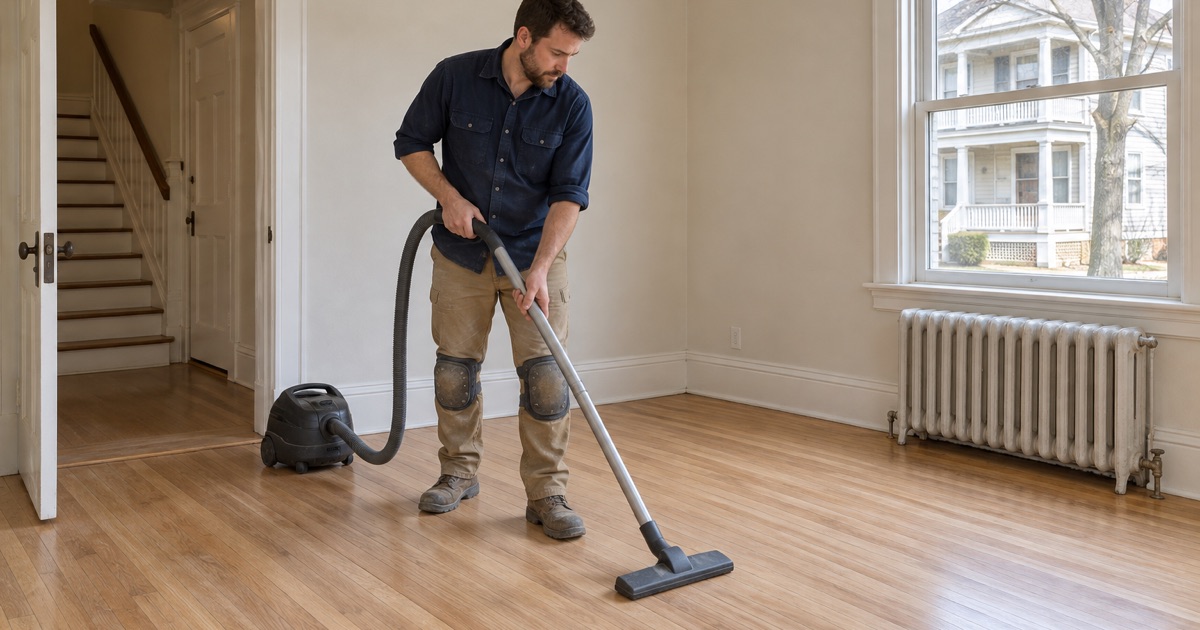
Drum sanding is loud, and in a stacked two-family the sound carries through the framing into the unit above or below. We set working hours with you in advance so the other household knows which days will be loud, and our sanders run into HEPA vacuum collection so dust stays in the room being worked instead of drifting into shared halls.
Finish choice matters here as well. A waterborne polyurethane dries faster and carries less odor than an oil-modified one, which is often what settles the question when someone is living on the other side of a door. Whatever we use is chosen to fit the Massachusetts VOC limits for wood coatings, which are stricter than the federal ones.
Owner Unit and Rental Unit
The two units of one house often want different things. An owner refinishing the unit they live in may choose a hardwax oil, a custom stain or a lower sheen level, while the rental unit usually needs a durable, easy-to-maintain finish that holds up to traffic lanes and moving day. We are glad to quote the two differently rather than force one spec on the whole building.
Turning a rental unit between tenants runs on its own clock. Landlords usually have a narrow gap between one lease and the next, so we sequence repairs, sanding, coats and cure time to fit that window, and we say plainly when the gap is too short for the finish you had in mind. Pet urine stains and water stains are assessed at the walkthrough, since they decide whether boards come out.
Stairs and Halls Shared Between Two Units
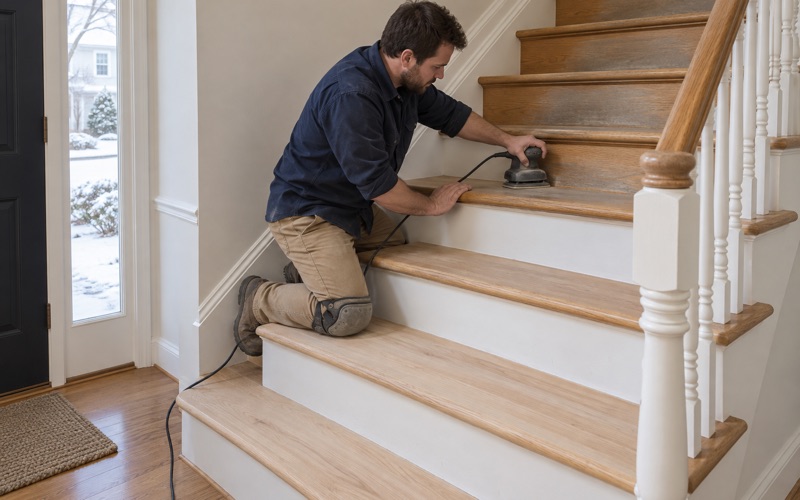
In many two-families a front stair serves both households, so it cannot simply be closed for three days. We often refinish shared stairs in halves, doing alternate treads or one side at a time, so there is always a safe way up and down while the finish cures. A shared landing or hallway gets the same staging, since it may be the only route between a unit’s door and the street.
Stairs are quoted by the tread and the riser, not folded into a square-foot price. Worn stair nosing, split treads and painted risers are listed on their own lines, so you can see exactly what the stair is getting and schedule the other household around it.
Before the Sander: Lead, Moisture and Wear Layers
Lead-Safe Work in Older Rooms
With 79.9 percent of Newton’s housing built before 1980, many of the floors we sand in the city are in homes built before 1978, and Massachusetts runs its own lead-safe renovation rules for those homes. We check the build year and look at painted surfaces, including baseboards, quarter round, stair risers and any painted floor borders, before sanding starts.
Where painted surfaces will be disturbed, we plan the work around the lead-safe practices set out under the Massachusetts Lead Law and the federal TSCA Title VI renovation rules. In a two-family that plan covers the shared stair and hall as well as your unit, because dust from painted trim does not stop at a unit’s door.
Seasonal Movement and Leaks
Old floors move with the seasons. Winter heat dries the house and opens winter gaps between boards, while humid summers close them again or, where moisture collects below the floor, push boards into cupping. We read boards with a moisture meter before refinishing or replacing anything, so a seasonal gap is not mistaken for damage and a real moisture problem is not sanded flat only to return.
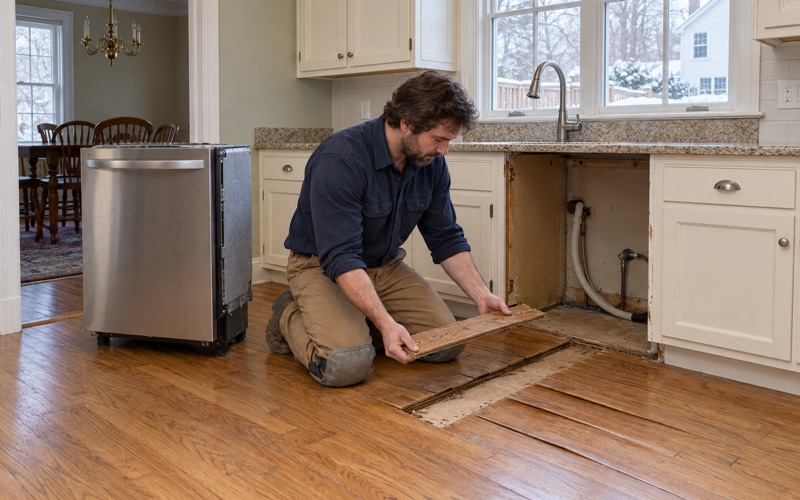
Leaks are traced before boards come up. A dishwasher, an ice maker line or a hot-water baseboard pipe can wet a floor for weeks before a stain shows. We find the source, dry the boards, confirm the readings, and when insurance is involved, document the damage room by room for the adjuster.
Engineered Floors in Later Additions
Not every floor in an older house is original solid wood. Kitchens and additions from recent decades sometimes carry an engineered floor on a plywood core, and its wear layer sets a hard limit on sanding. We measure that wear layer before promising a refinish, and if it cannot take another sanding, we tell you so and talk through a screen and recoat or replacement instead.
Historic Districts Review Exteriors, Not Your Floors
Newton has four local historic districts, Newton Upper Falls, Chestnut Hill, Newtonville and Auburndale, with 887 properties among them, and each district has its own commission. Under the city’s ordinance, no exterior feature visible from a public way may be changed in those districts without a Certificate of Appropriateness.
That review is about what the street sees. Refinishing the parlor floor of an Auburndale house or replacing kitchen boards in a Newtonville two-family is interior work, and the district review as the city describes it covers exterior features. A porch floor visible from the street is a different case, and owners in a district should check with its commission before we touch one.
The Newton Historical Commission runs a separate process. Under the 1985 Demolition Review Ordinance, any building 50 years old or older, garages and sheds included, is reviewed before total or partial demolition, and demolition of a historically significant building can be delayed up to twelve months, or eighteen for properties listed on or eligible for the National Register. That concerns demolition rather than floor finishes, but owners folding floor work into a larger renovation should know it exists.
From Auburndale to Waban
Wherever the house sits, from Auburndale to Waban and from Nonantum to Oak Hill, the first visit follows the same order. We look at the floor, confirm the build year, ask who lives in the other unit if there is one, and then write a quote that covers what we actually found rather than what an average Newton house might hold.
- 20+ Years on Wood Floors
- Free Written Estimates
- Lead-Safe Work Practices