Framingham Wood Flooring brings more than 20 years to wood-flooring in Needham, and the bulk of that work is repair and refinishing on floors people already own. We sand, stain, finish, patch and rebuild hardwood in houses where the owner expects to keep living for a long time. That changes how we price a job, because the goal is a floor that holds up through the next stretch of ownership rather than one that simply photographs well for a sale.
A typical call starts with a floor that has gone dull in the traffic lanes, turned orange under an old finish, or picked up water stains near a kitchen or a radiator. Sometimes it is a room of hardwood found under wall-to-wall carpet. We look at the boards, read the moisture, and measure how much wood is left before we say what a floor can take.
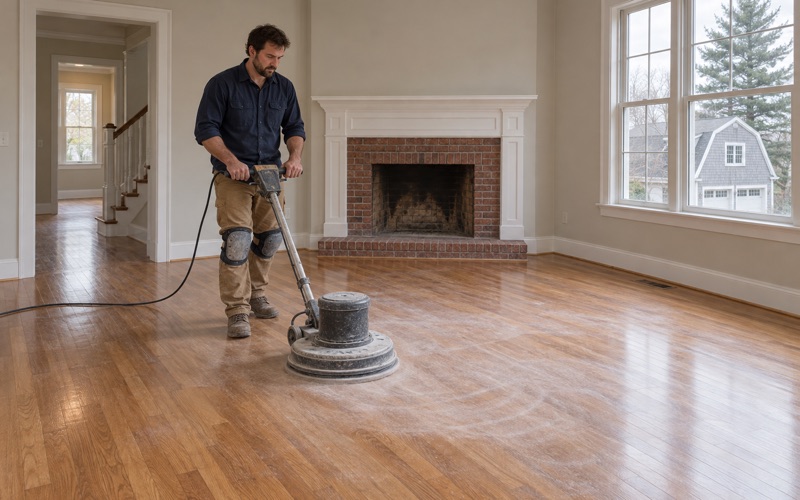
Our crews sand with dust control, running every machine into HEPA vacuum extraction, and we finish with coatings that meet the Massachusetts VOC limits for wood finishes, which are stricter than the federal ones. The sections below cover what we find most often in town and how we plan around it.
Floors in Needham’s 1950s Houses
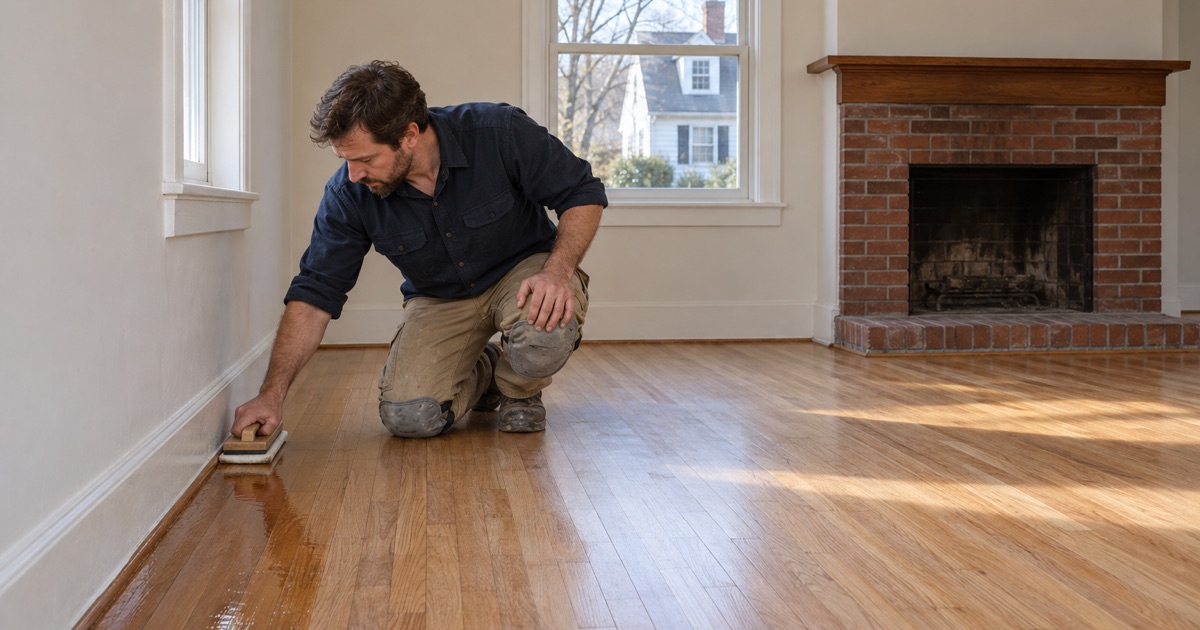
The 1950s are the largest build decade in Needham. According to the Census Bureau’s American Community Survey 2024 five-year estimates, 2,359 of the town’s 11,929 housing units went up between 1950 and 1959, or 19.8 percent of the stock. Add the older layers and 45.1 percent of all units were built before 1960. For a floor contractor, that means a large share of the rooms we walk into have been lived on for well over half a century.
That decade followed a change in the shape of the town. After World War II, the northern side of Needham along Route 128 was developed for light industry. We do not treat the houses that went up in those years as a single type, because they are not one, but the age of the floors in them is a fact we plan around from the first visit.
These houses are also, overwhelmingly, lived in by the people who own them. The same survey counts 9,632 of Needham’s 11,586 occupied homes as owner-occupied, or 83.1 percent, and 8,537 owner households live in detached houses. A floor in a house owned for decades has usually been through more than one round of care, and that history is what we read before recommending anything.
What a Floor of That Age Tends to Show
After this many decades, the problems are rarely dramatic. We see traffic lanes worn through the finish in hallways, board gapping that opens wider in winter, gray water stains around old radiators and hot-water baseboard, and pet urine stains that have gone black at the edges. Now and then a board is cupped or crowned from an old leak that was fixed years ago but never dried properly.
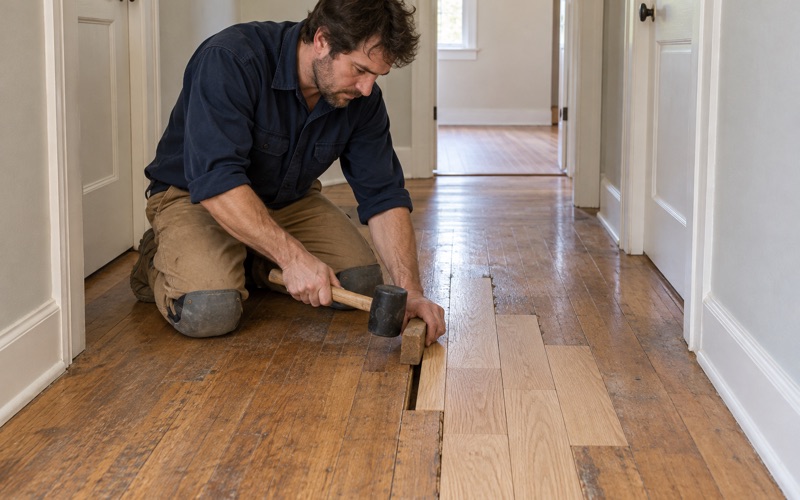
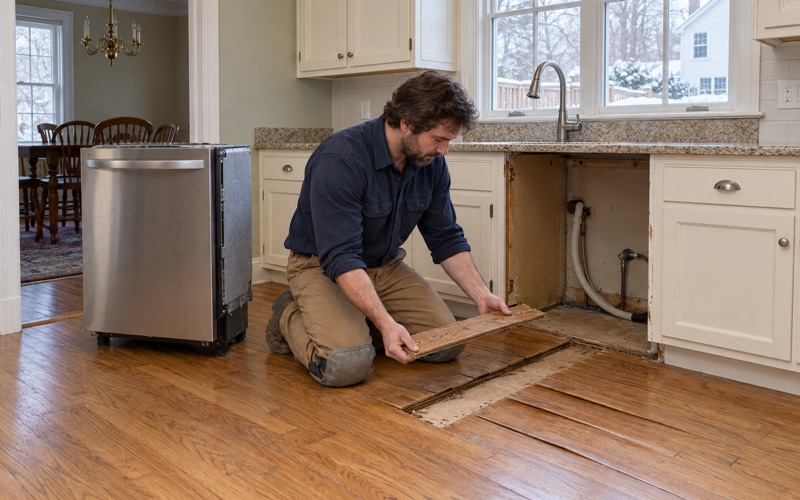
Most of that is repairable. A weave-in repair replaces damaged boards by staggering new ones into the surrounding field so the patch does not read as a rectangle, and a full sanding then blends the repair into the room. Where a leak from a dishwasher, an ice maker line or a baseboard pipe is still active, we trace it and dry the boards first, checking them with a moisture meter before anything is replaced.
Checking the House Before We Sand
A floor laid in the 1950s sits in a house built well before 1978, and Massachusetts runs its own lead-safe renovation rules for homes of that age under the Massachusetts Lead Law and 454 CMR 22.00. Before sanding starts, we confirm the build year and look for painted surfaces the work will disturb, such as painted thresholds, stair risers, baseboard and shoe molding. That check decides how we contain the room, not whether the floor can be done.
Species and grade vary from house to house, so we identify them in the room rather than assume them. Red oak, white oak and maple each take stain differently, and a select grade floor shows color change more plainly than a character grade one. If you are not sure what is under your finish, we can usually tell you after a few minutes with the boards.
Looking for wood-flooring closer to Medfield? See Wood-Flooring in Medfield.
Needham Heights and Needham Center
Two parts of town frame this page: Needham center, around the Town Hall that was dedicated in 1903, and Needham Heights, the 02494 ZIP code on the northern side. Needham Heights has an industrial past of its own. It was historically home to William Carter’s knitting mill, which operated there from 1865.
Town-wide, the housing spans several eras. Alongside the postwar peak, 23.3 percent of units were built in 2000 or later, so neighboring houses can hold floors laid decades apart. When we quote, we treat each house on its own terms rather than assuming the one next door had the same floor or the same history of care.
Seasonal Movement in Western Norfolk
Needham sits in the National Weather Service forecast zone for Western Norfolk, MAZ013, and like the rest of eastern Massachusetts it swings between dry, heated winters and humid summers. Solid hardwood follows the air. Boards shrink and open winter gaps once the heat comes on, then close again as the humidity rises.
We tell owners to expect some seasonal gapping in an older solid floor and not to fill every crack in January. Wood filler packed into a winter gap gets crushed out when the boards swell in summer. Where gaps stay open year round, replacing a few boards is the honest fix, and we will say so rather than trowel filler over the problem.
Humidity also governs our schedule. We read the subfloor and the boards with a moisture meter before sanding and again before any new wood goes down, and new material is left to acclimate in the house before installation. An oil-modified polyurethane cures more slowly in damp weather, so on humid weeks we often steer owners toward a waterborne polyurethane.
Living in the House During the Work
Because most of these floors are in houses the owners live in, the job has to work around a household. We plan room by room where the layout allows, keep furniture moves to what is needed, and tell you how long each coat must cure before feet, then rugs, then furniture can go back. Dust control matters more when the family is sleeping down the hall.
Refinishing a Floor That Has Been Sanded Before
A floor in a house owned for decades has often been sanded once or twice already, and each sanding takes wood off the top of the board. A solid tongue and groove floor has only so much wood above the tongue. Before we promise a full sanding, we pull a floor register or check a threshold edge to see how much is left.
When a Screen and Recoat Is Enough
If the finish is worn but the wood underneath is not stained or deeply scratched, a screen and recoat is the lighter option. We abrade the existing finish with a buffer, clean the floor, and apply fresh coats without cutting into the wood. That keeps the remaining thickness for a later sanding, which matters on a floor that may already be thin.
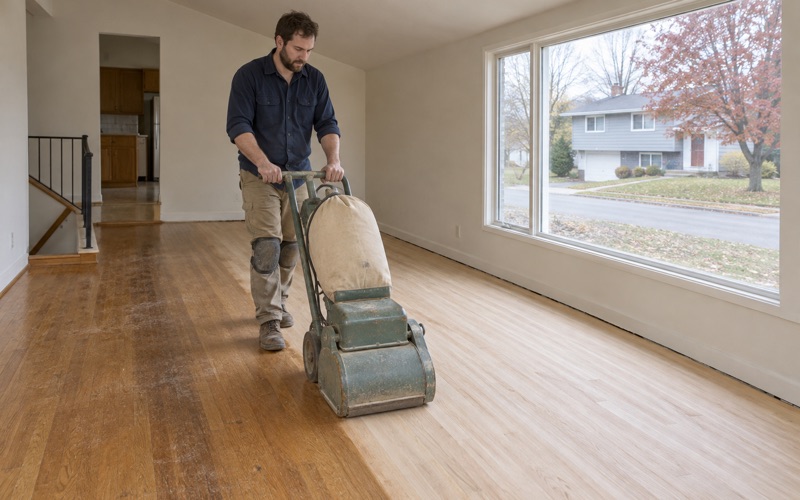
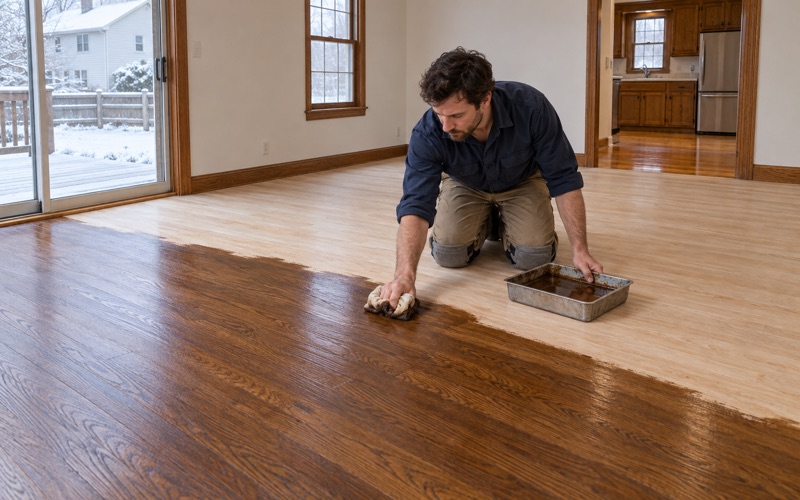
When the damage is in the wood itself, we sand. We run a grit sequence with a drum sander on the field and an orbital sander along the walls and in corners, with HEPA vacuum extraction on every machine. Before stain, we lay stain samples on the actual floor, often after water popping the grain, so the color reads the way it will across the whole room.
Changing the Color of Orange Oak
Orange oak is one of the most common complaints we hear about an older floor. Sanding back to bare wood removes that yellowed tone, and from there we can take the floor to a natural look or a modern gray or brown. We show you the options as samples on your own boards first, because the same stain reads differently on red oak than it does on white oak.
Needham’s Prewar Houses
The 1950s are the largest layer, but they are not the oldest. The survey counts 2,151 units, 18.0 percent of the town, built in 1939 or earlier, and those floors are a different job from the postwar ones. Floors in prewar houses have often been sanded more times, patched more times, and in some rooms covered and uncovered more than once.
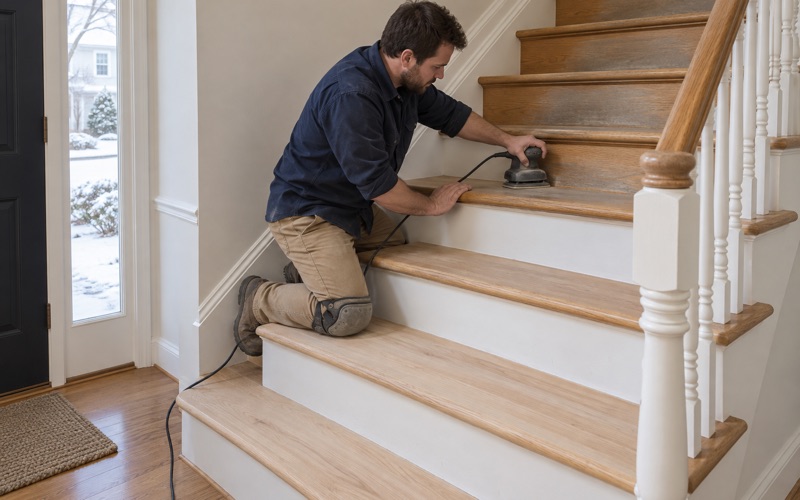
In older houses we check closely for board thickness, loose boards over the subfloor, old face nails, and signs of powderpost beetle or carpenter ants in boards near exterior walls. Where a board is too thin or damaged to sand, we replace it with matching stock and weave it in. Stair treads, risers and nosing are quoted by the tread and riser, not rolled into a square-foot price.
Planning a Floor Project in Needham
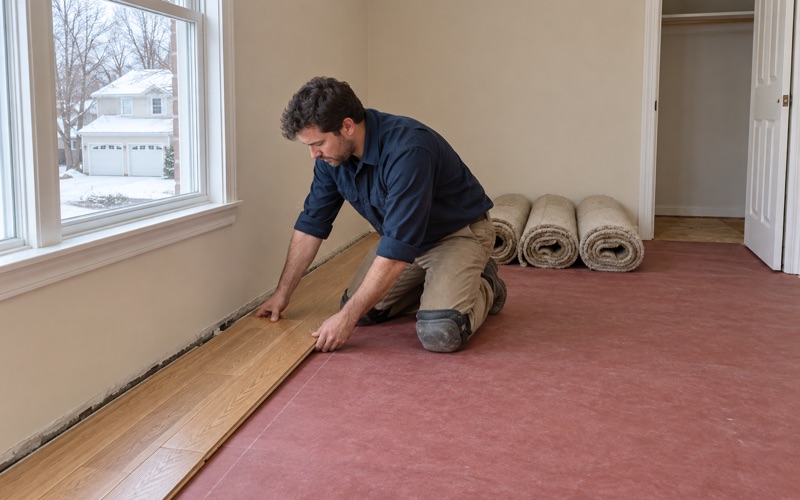
Carpet is often where a project begins. When we pull carpet and find hardwood, we remove the carpet pad, carpet staples and tack strip, and repair the tack-strip holes before sanding rather than after. Staples left in the floor tear sandpaper and gouge boards, so this cleanup is part of the quote from the start.
Sanding, Repair or New Flooring
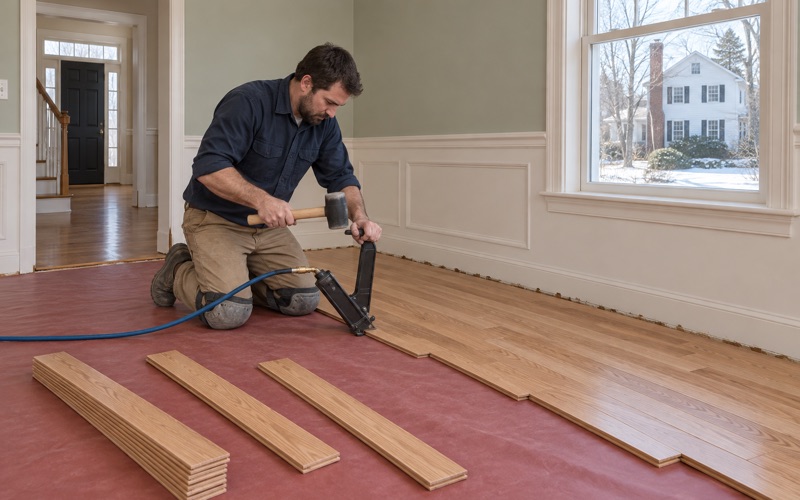
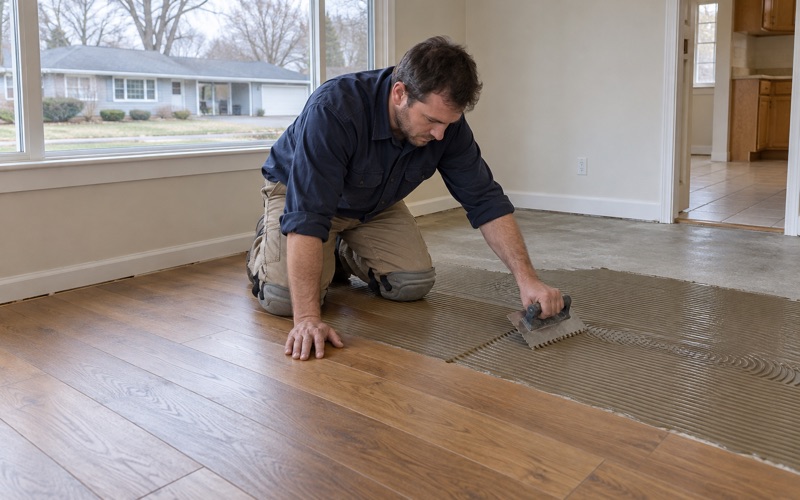
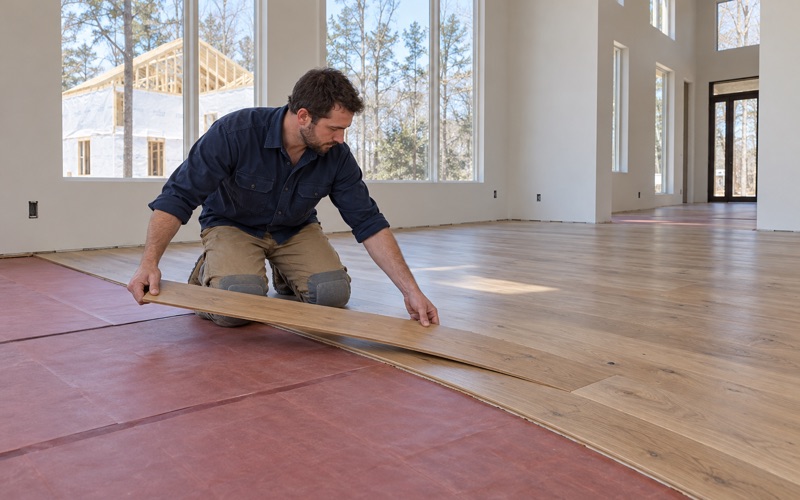
Not every room should be sanded. If an earlier owner laid an engineered floor, we measure the engineered wear layer before promising a sanding, since a thin wear layer may allow only a screen and recoat. Where a floor is past saving, we talk through solid hardwood or engineered boards with a plywood core, nail-down or glue-down installation, and how the new floor meets the old one at each threshold and reducer.
Water damage is its own kind of project. When a leak has cupped or buckled a floor, we find the source, dry the boards and read them with a moisture meter, and only then decide which boards to replace. If an insurance claim is involved, we document the damage room by room for the adjuster.
What to Expect From Us
A Needham floor job with us starts with a visit, a moisture reading and a written scope that separates sanding, repair, stairs and finish. We tell you which finish we recommend and why, whether that is a waterborne polyurethane, an oil-modified polyurethane or a hardwax oil, and what sheen level suits the room. Then we schedule the work around your household, not the other way around.
- 20+ Years on Wood Floors
- Free Written Estimates
- Lead-Safe Work Practices