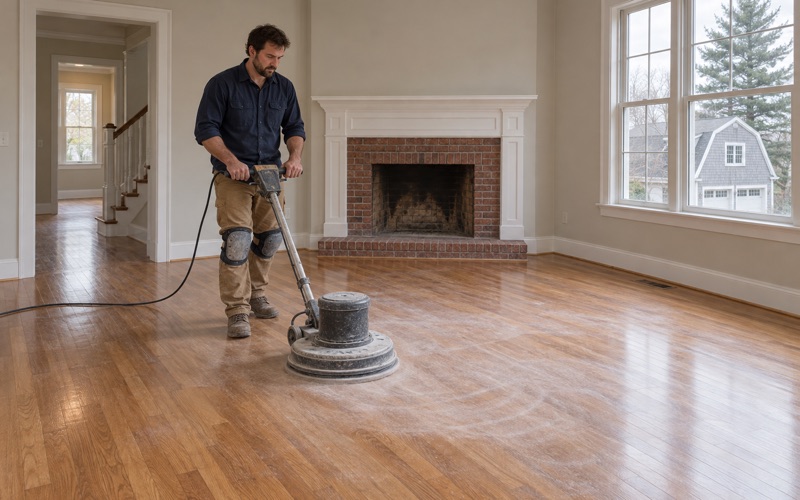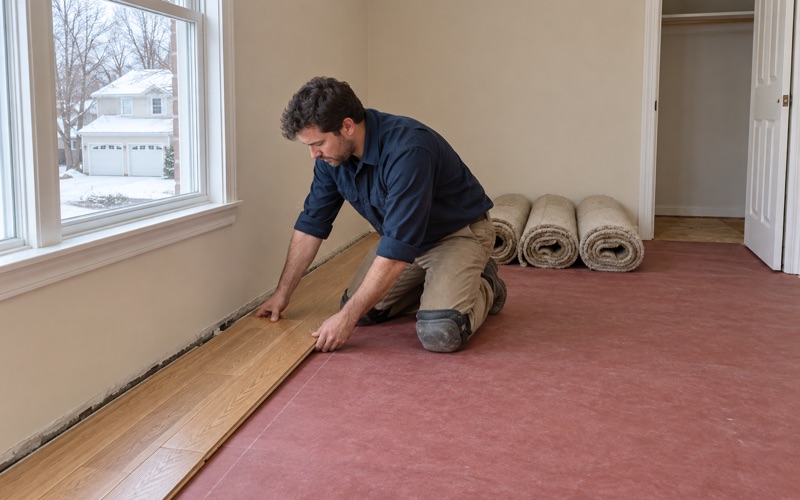
Framingham Wood Flooring has spent more than 20 years on wood-flooring in Milford and the towns around our Framingham base, and a good share of that work happens in buildings where somebody else will be living on the floor next month. We refinish, repair and install hardwood for landlords, for owners who live on one floor of a two-family and rent the other, and for single-family homeowners. The work changes depending on who pays for it and how long the floor has to last before the next turnover.
For a rental, the question is rarely how to make a floor perfect. It is how to get worn oak back to a clean, sealed, even surface inside the gap between one lease ending and the next one starting, without cutting through what is left of the board. We plan that job around the move-out date, the unit’s finish history and how much sanding the wood can still take.
For a floor the owner lives on, the pace is different and the choices open up: stain color, sheen level, a full sand rather than a recoat. Either way we start with the same checks, including the age of the house, the condition of the boards and anything painted that a sander might reach, before we write a quote.
Wood Floors in Milford’s Two-Families and Small Apartment Buildings
Milford’s housing leans old. Of the town’s 11,627 housing units, 2,623 were built in 1939 or earlier, which makes that the largest single build-year bucket at 22.6 percent, and 63.8 percent of all units predate 1980. Those figures come from the Census Bureau’s 2024 five-year American Community Survey, and they fit what we find when carpet comes up in an older unit: narrow strip oak that has already been sanded more than once.
The rental side of the picture is just as clear. About 34.8 percent of Milford households rent, 3,906 of them, and 1,700 of those renter households live in buildings with two to four units. The town has 1,161 units in two-unit buildings and 1,379 in three- and four-unit buildings, 21.8 percent of its housing combined. That adds up to a lot of small landlords and a lot of floors that turn over on a lease cycle.
What rental floors usually need
A rented floor wears in traffic lanes: from the entry to the kitchen, down the hallway and in front of the sink. The finish breaks through first along those paths, then the bare wood grays and picks up water stains. Pet urine stains show up as dark patches near doors and in bedroom corners, and they often run deeper than a sanding can reach.
When the finish is worn but the wood beneath it is sound and unstained, a screen and recoat is the fast turnover option. We abrade the existing finish with a buffer, vacuum and tack the floor, and lay down a fresh coat of polyurethane, which can often fit inside a short vacancy. When the wood itself is gray, stained or gouged, the floor needs a full sand, and that takes longer.
Solid boards and engineered floors
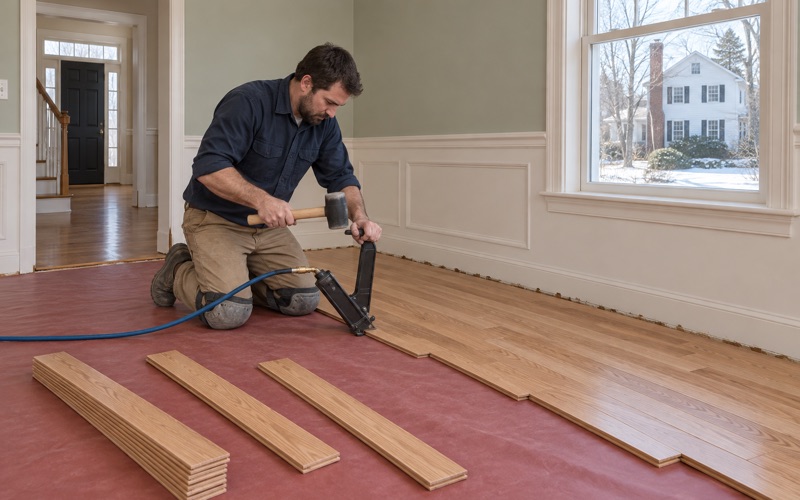
Most of the older floors we open up are solid hardwood, tongue and groove, blind-nailed through the edge or face-nailed where a board was reset. Solid boards can be sanded several times, but each pass takes wood, and a floor refinished between many tenants may be close to its limit. We check the thickness above the tongue at a floor register or threshold before promising another full sand.
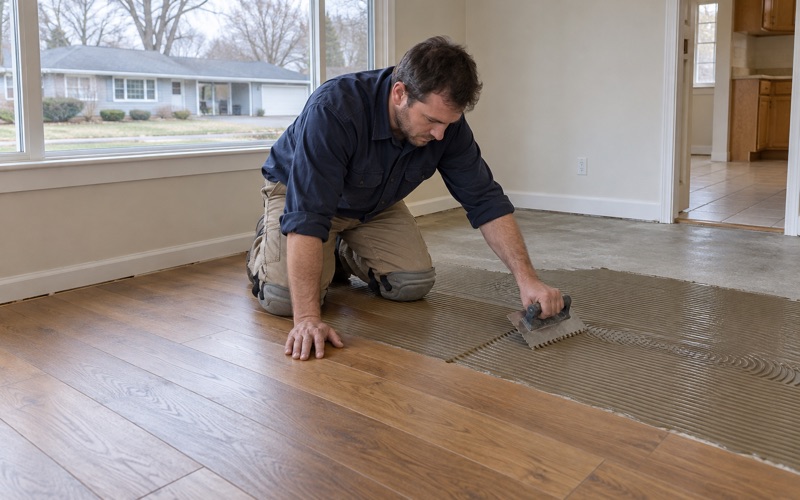
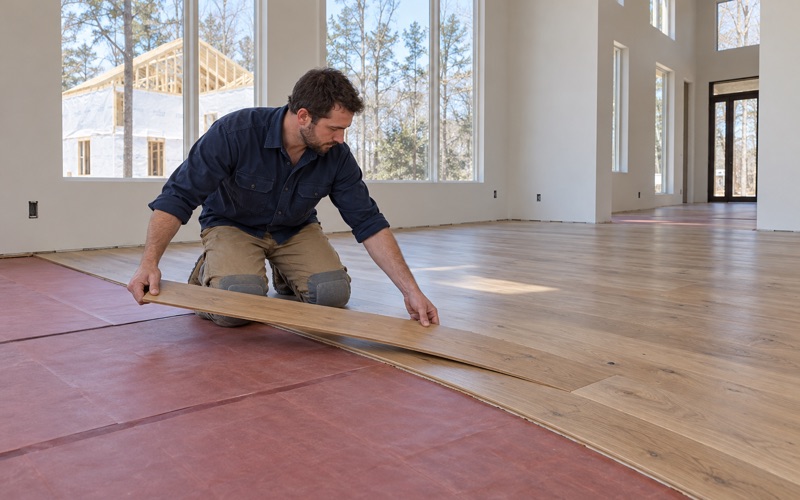
Newer units may have engineered flooring instead. For those we measure the engineered wear layer before any sanding is promised, because a thin layer over a plywood core can take a light screen but not a drum sander. Some prefinished engineered products are better recoated than sanded at all, and we say so up front.
Looking for wood-flooring closer to Newton? See Wood-Flooring Services in Newton.
Refinishing Between Tenants and the Mass Occupancy Permit
The Milford Board of Health runs a Mass Occupancy Certification Program. According to the town, multi-unit buildings and non-owner-occupied buildings need a Mass Occupancy Permit, and the Board of Health issues those permits after an on-site inspection. The town also states that fees for the program have been suspended and that there is no longer a renewal fee, and inspections are scheduled through the Board of Health at (508) 634-2315.
We do not tell landlords what that inspection looks at, because the town’s program page does not say, and we will not guess. What we can do is plan around it. If an inspection date is already on the calendar, we work backward from it so the finish has cured and the unit is clean and clear of our equipment before anyone walks through.
A typical turnover sequence
Most between-tenant jobs follow the same order. We walk the empty unit, note traffic lanes, stains, gaps and loose boards, and check any suspect area with a moisture meter. Then we choose between a screen and recoat, a spot repair plus recoat, or a full sand to bare wood. Repairs come first, sanding second and finish last.
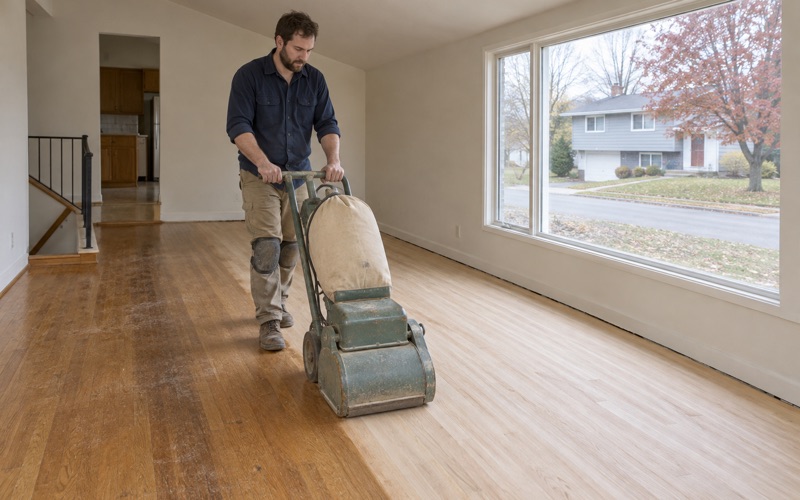
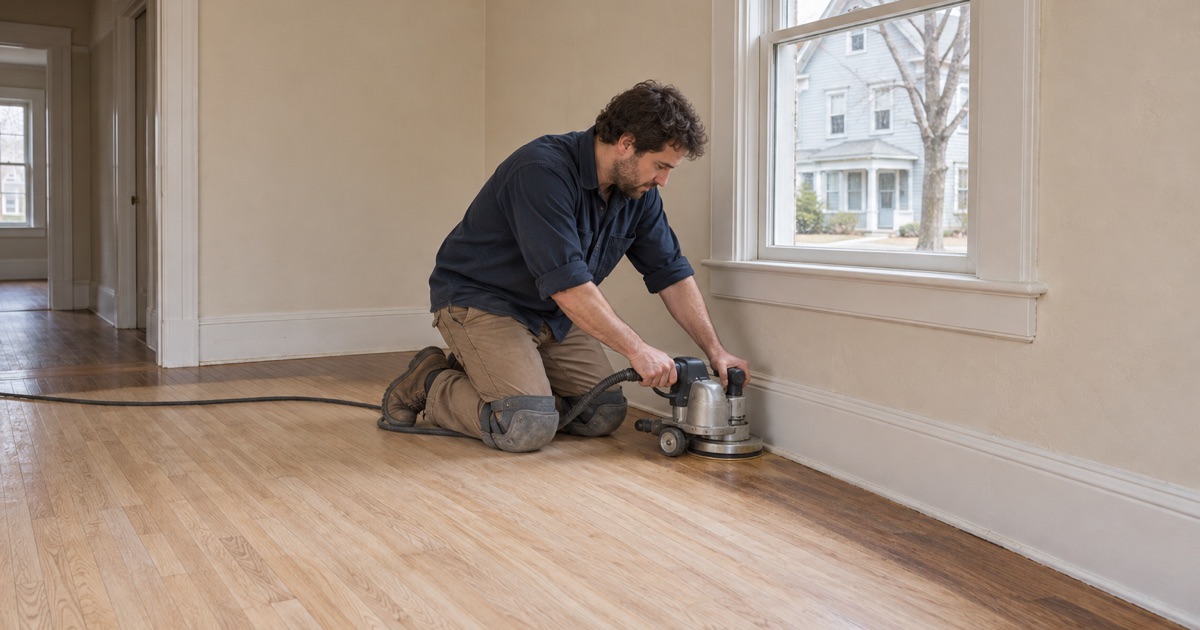
For a full sand we run a drum sander through a grit sequence on the open floor, an edger along the walls and an orbital sander to blend the two, with dustless sanding equipment and a HEPA vacuum between passes. That matters in a two-family or a small apartment building, where the people above or below are still living there while we work.
Finish choice for a rental is mostly about dry time and durability. A waterborne polyurethane lets a unit reopen sooner and does not yellow, and we pick products that fit the Massachusetts VOC limits for wood coatings, which are stricter than the federal ones. An oil-modified polyurethane gives the familiar amber look but needs more time before furniture goes back in.
Paint and lead in older units
With so much of Milford’s housing built before 1980, we check the build year and look for painted surfaces before any sanding starts. Massachusetts runs its own lead-safe renovation rules for homes built before 1978, and a painted baseboard, stair or threshold can bring a floor job under them. We sort that out at the walkthrough, not halfway through the first pass.
Older Floors in Prospect Heights and North Milford Village
Two Milford neighborhoods are on the National Register of Historic Places. The Prospect Heights Historic District was built in 1903 by the Draper Corporation for its immigrant workers and was listed in 1990, and it has long been home to Portuguese, Irish, Italian, Greek, Armenian and Polish communities. The North Milford Village Historic District entered the National Register on April 21, 2000.
We treat those listings as history, not as a floor specification. The Milford Historical Commission, established by the Board of Selectmen in 1971, is the local body for historic matters. On a floor job in either district, the practical questions are about the wood itself: how many times it has been sanded, whether the boards are original, and whether earlier repairs used a matching species. The town’s pink granite, discovered in 1870 and quarried until about 1940, is local color rather than a flooring topic.
What we look for in a floor over a century old
Floors this old have usually been refinished several times. We look at how much wood remains above the tongue at the edges, how close old nail heads sit to the surface, and whether boards have been face-nailed back down after lifting. Board gapping is common, and winter gaps that open in the heating season and close again in summer are normal movement, not something to pack with rigid wood filler.
Old boards can also carry insect damage. Small round exit holes can point to powderpost beetle, and soft, hollowed wood near a damp sill can mean carpenter ants. We identify either one before any sanding, because refinishing over active damage only hides it until the next tenant finds it.
Repairs Before a Refinish, and Owner-Occupied Two-Families
Repairing worn boards first
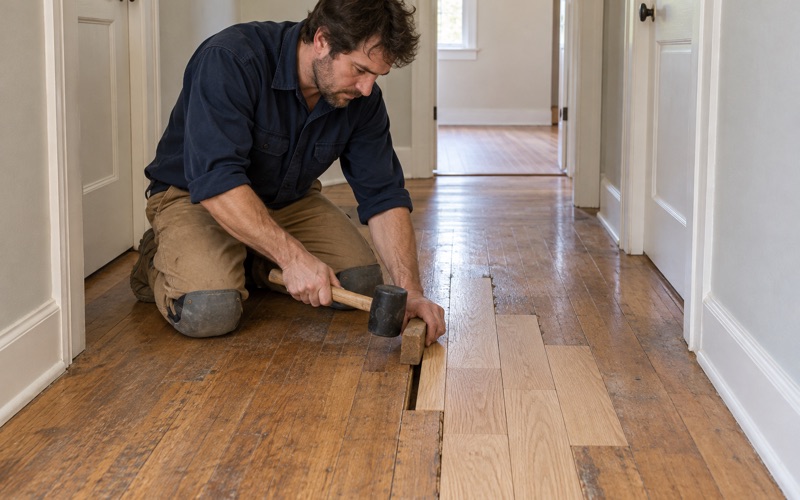
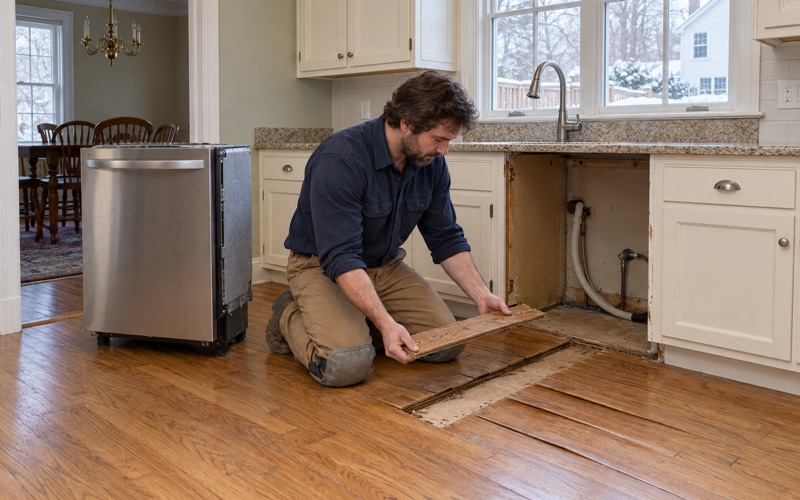
Refinishing a floor with loose, split or stained boards only seals the damage in. Before sanding, we pull the damaged boards and do a weave-in repair, staggering the new pieces into the existing pattern so the patch does not read as a square. We match species and width where we can, red oak with red oak and white oak with white oak, and let the new wood acclimate in the unit first.
Water is the most common reason a rental floor needs boards replaced. A leaking dishwasher, a failed ice maker line or a weeping hot-water baseboard pipe can leave cupping or crowning across a room, and in bad cases buckling. We trace the source, dry the boards and read them with a meter before replacing anything, and when an insurance claim is involved we document the damage room by room for the adjuster.
Repair or full refinish?
For a landlord, the choice usually comes down to how much of the floor is affected. A few bad boards in an otherwise sound floor can be replaced and blended in with a screen and recoat. When stains, gray wear and patches cover most of the room, a full sand gives a more even result and a fresh finish to carry the unit through the next several leases.
Living on one floor and renting the other
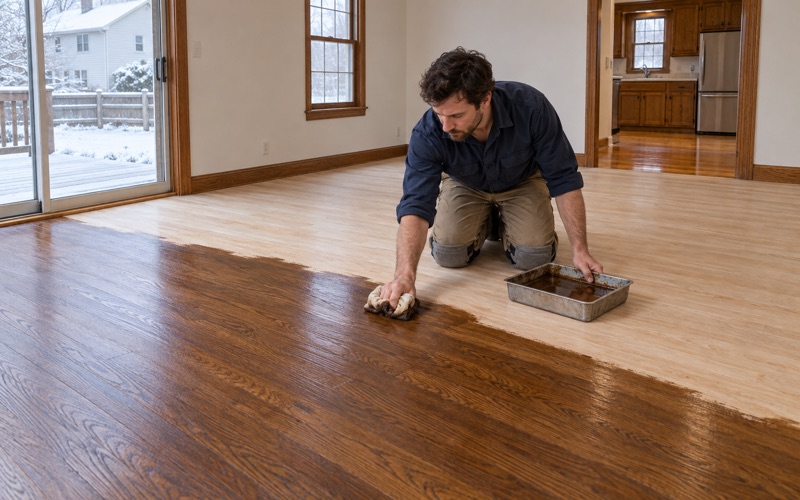
Owner-occupants are part of Milford’s small-building market too: 393 owner households live in two-unit buildings and 239 in three- or four-unit buildings. An owner often wants something different on the floor they live on than in the rental. Their own unit might get stain samples on the actual floor to move orange oak toward a natural tone, a hardwax oil or a lower sheen, while the rented unit gets a durable, fast-curing finish.
Doing both units in one visit can save a second setup, but it means planning around the household that stays in the building. We usually sequence the rental first, while it sits vacant, and schedule the owner’s floor for a stretch when the family can keep off it, so the two jobs never overlap.
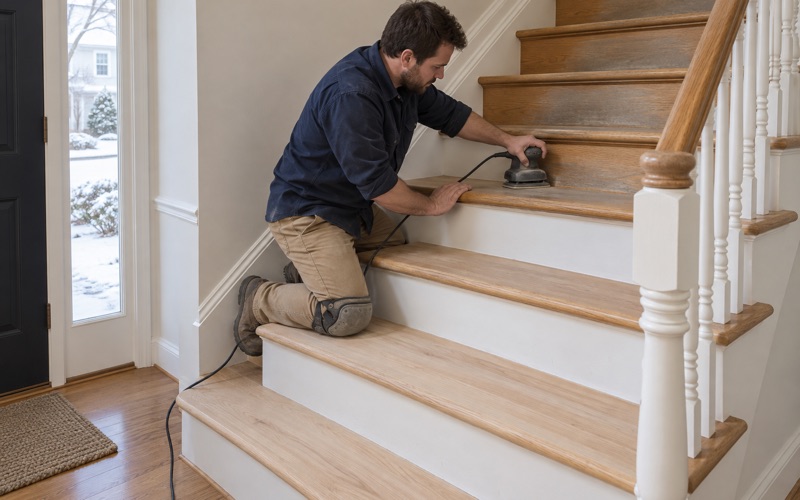
Stairs between the floors are quoted by the tread and riser rather than folded into a square-foot price, because stair treads, risers and nosing take hand work a drum sander cannot do. The shared stair and hallway also take the hardest traffic in a two-family, so we look at them closely whenever we quote either unit.
- 20+ Years on Wood Floors
- Free Written Estimates
- Lead-Safe Work Practices