Framingham Wood Flooring has spent more than 20 years on wood-flooring in Medfield and the towns around our Framingham base, and most of that work comes down to two jobs. One is bringing a worn floor back with a full sanding and a new finish. The other is fixing the boards that have been damaged along the way, in houses where the floor has already seen decades of daily use.
Before any machine touches a floor, we check the year the house was built and look for painted surfaces nearby, since Massachusetts sets its own lead-safe renovation rules for homes built before 1978. We also read the boards with a moisture meter, look for cupping or crowning, and ask how each room is used, so the plan fits the floor in front of us rather than a standard package.
From there the options are laid out plainly. A screen and recoat suits a finish that is only dull, a full sand and refinish suits wear that has reached bare wood, and targeted board replacement handles a leak or a pet urine stain that has gone too deep to sand out. We price each option separately so you can compare them side by side.
Medfield’s 1960s and 1970s Houses, Kept for Decades
The housing numbers explain much of the work we see in town. The American Community Survey 2024 five-year estimates show the 1960s as Medfield’s largest build decade, with 1,107 of the town’s 4,820 housing units, or 23.0 percent, built from 1960 to 1969. Another 699 units, 14.5 percent, went up in the 1970s, which puts 37.5 percent of the housing stock in those two decades.
The houses are also mostly one kind of building. Of those 4,820 units, 3,912, or 81.2 percent, are one-unit detached houses, and 86.1 percent of occupied homes are owner-occupied. Among owner households, 90.8 percent live in a detached house. In practical terms, a typical Medfield floor job is in a single-family house whose owner is planning around the long run, not a quick sale.
What Floors From That Era Tend to Need
Floors installed in the 1960s and 1970s have now carried half a century of foot traffic, furniture and seasonal movement. The wear rarely shows up as a single problem. More often it is a stack of them: traffic lanes worn through the finish in halls and kitchens, winter gaps that open between boards when the heat runs, earlier refinishes that left the oak orange, and the occasional water stain near a sink or radiator.
Why the Lead Check Matters Here
By the same census count, 64.0 percent of Medfield’s housing units were built before 1980, so many of these homes fall within the pre-1978 range the Massachusetts Lead Law addresses. Painted baseboards, quarter round and stair risers are exactly the surfaces a sanding job can disturb. We confirm the build year and look at that trim first, then plan containment and cleanup around what we find.
Looking for wood-flooring closer to Northborough? See Wood-Flooring Services in Northborough.
Refinishing a Floor in a House You Plan to Keep
When an owner expects to stay another ten or twenty years, the refinish-or-replace question changes. Solid hardwood nailed over a wood subfloor can usually be sanded several times across its life, so a floor with enough wood left above the tongue and groove is normally worth keeping. Replacement makes sense when boards are loose, split or rotted across a room, not simply because the finish looks tired.
Screen and Recoat or Full Sanding
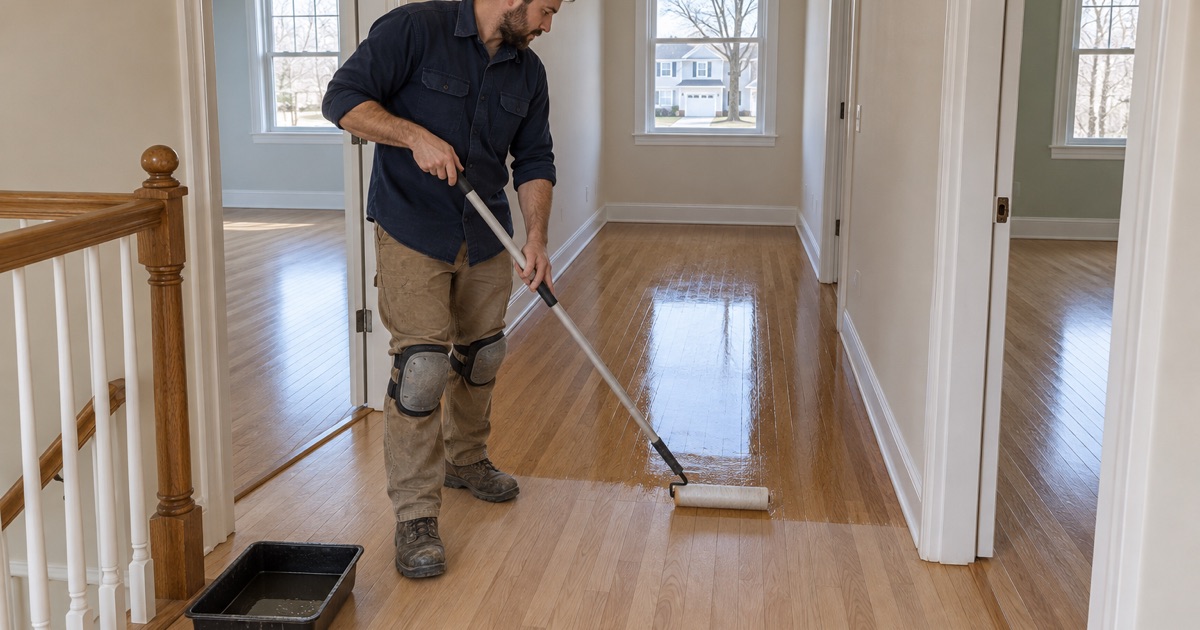
If the finish is scratched but intact, a screen and recoat can buy several more years. We abrade the top coat with a buffer and apply fresh polyurethane without cutting into the wood itself. Once traffic lanes have worn down to gray, bare wood, only a full sanding will even out the color, because new finish cannot hide boards that have already weathered.
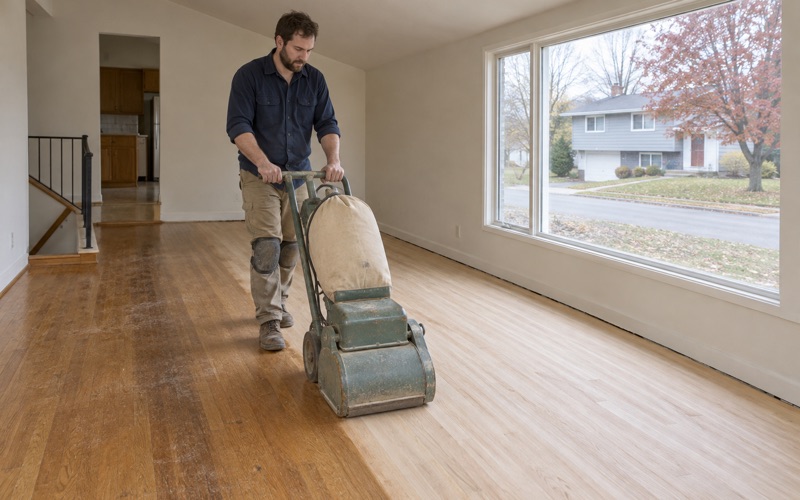
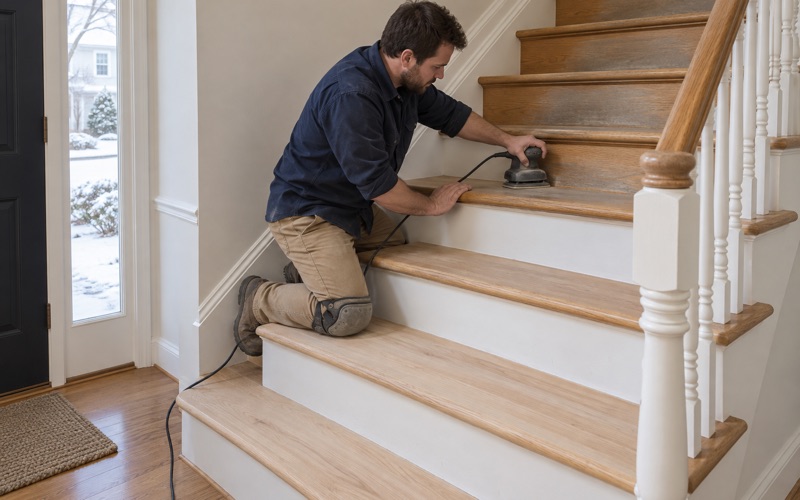
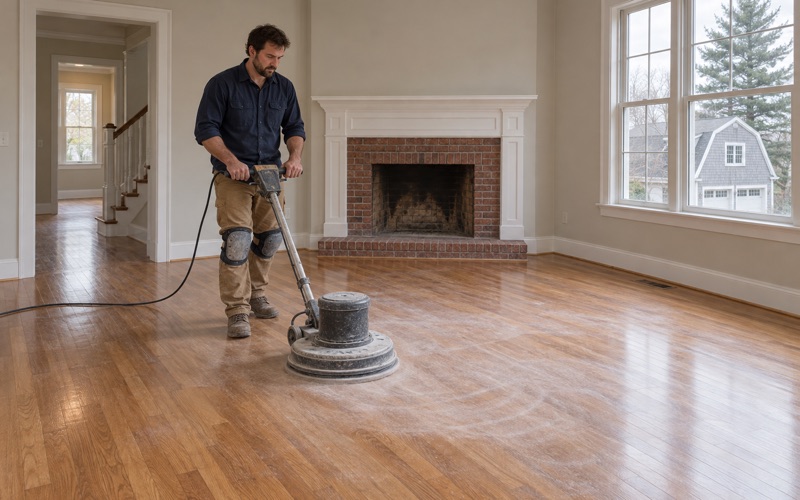
For a full sanding we run a drum sander through a set grit sequence, then work the edges and corners with an orbital sander. Our dustless sanding setup draws dust into a HEPA vacuum as we go, which matters in a house the family is living in during the job. Furniture moves room by room, and we plan the sequence so a kitchen or bedroom is out of use for as short a stretch as possible.
Taking Orange Oak to a New Tone
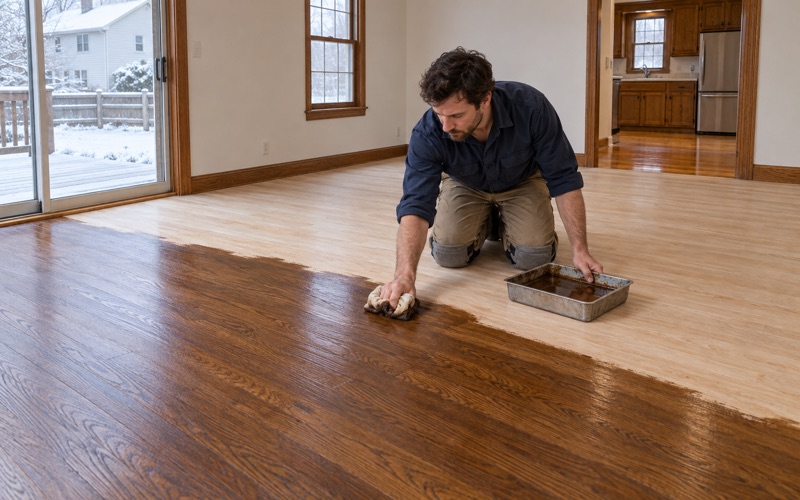
Red oak finished decades ago with oil-based products often ambers toward orange or yellow over time. Sanding back to raw wood gives a clean start, and from there we lay out stain samples on the actual floor, in the room’s own light, so you choose a natural or modern tone from what you can see rather than a printed chip. On red oak, water popping before staining helps the color take evenly.
Choosing the Finish
We use finishes that meet the Massachusetts VOC limits for wood coatings under 310 CMR 7.25, which are stricter than the federal limits. Waterborne polyurethane dries clear and keeps a lighter floor from yellowing. Oil-modified polyurethane adds warmth and cures more slowly, and hardwax oil gives a low-sheen look that can be spot repaired later. Sheen level is part of the choice too, since satin hides everyday wear better than gloss.
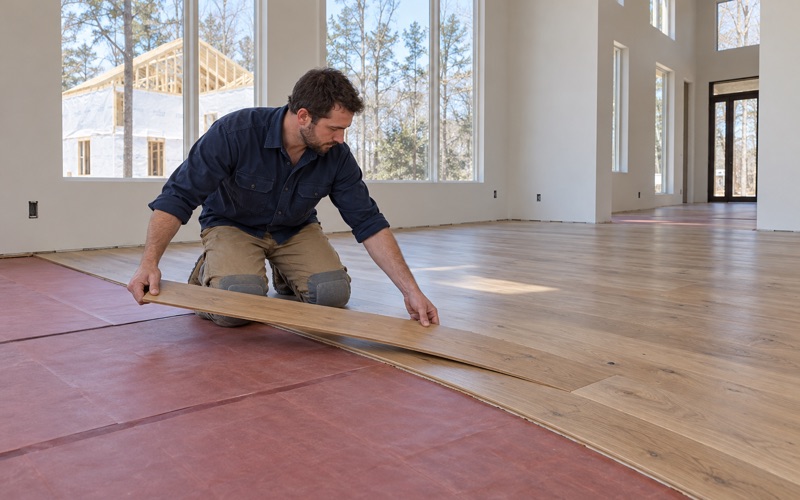
If a later addition or kitchen renovation brought in engineered flooring, we measure its engineered wear layer before promising any sanding. A thin veneer over a plywood core may handle a screen and recoat but not a full sand, and it is better to learn that before the drum sander comes out than after.
Repairing and Patching Mid-Century Floors
A floor that has been down since the Johnson or Nixon years has usually been through a few mishaps. Before any refinish we walk the rooms looking for boards that need attention first, because sanding over a split board or a deep stain only highlights it under new finish. Repairs come first, and then the whole floor is sanded together so the patch disappears into the room.
Weave-In Repairs and Board Replacement
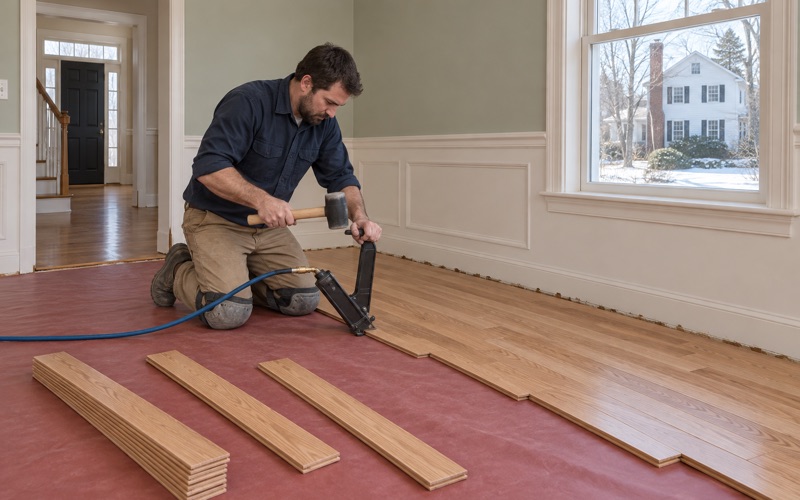
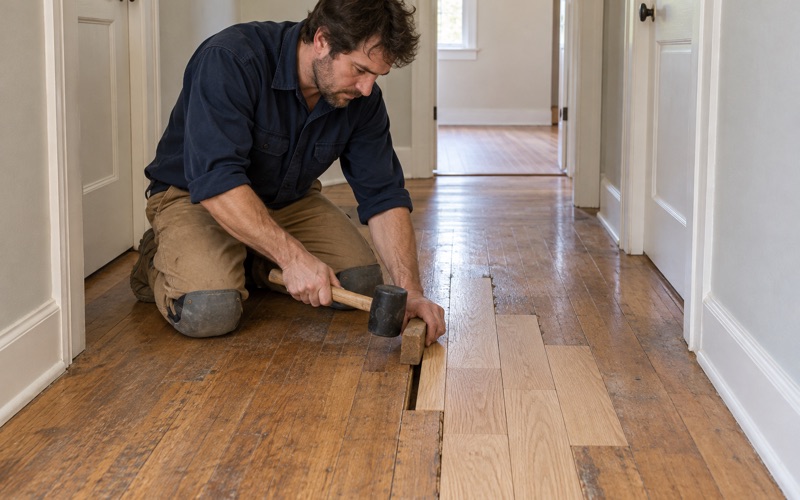
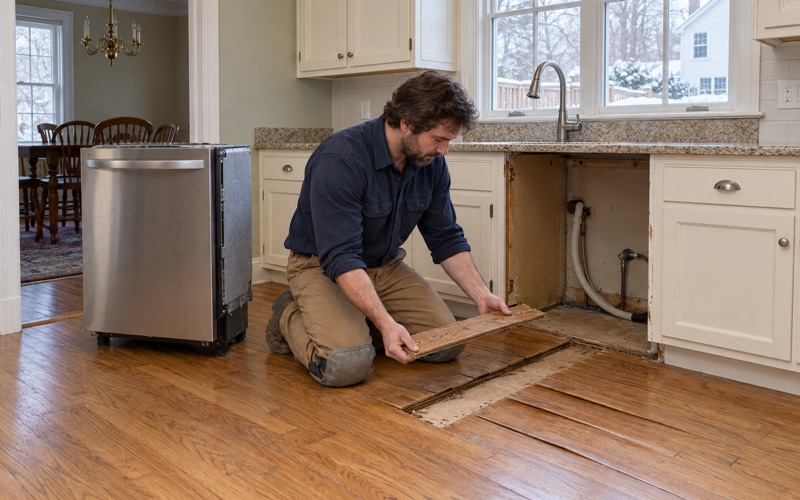
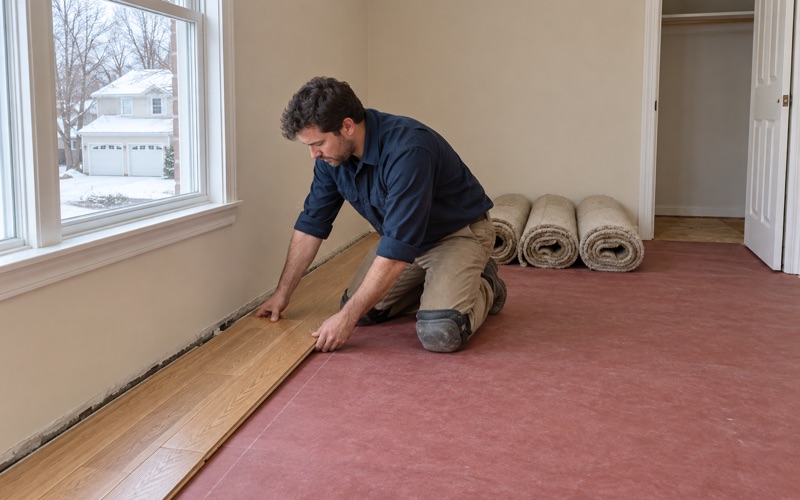
When a few boards are damaged, we cut them out and weave in new ones, staggering the joints so the repair follows the floor’s existing pattern instead of forming a square patch. We match species and width, whether the room is red oak, white oak or maple, and the new boards are sanded and finished with the rest of the floor. Small checks and nail holes take wood filler; anything larger gets a new board.
Small round exit holes and powdery dust along a board can point to powderpost beetles, while soft, hollowed wood near a damp spot can mean carpenter ants. Either one changes the job, because the affected boards have to come out and the cause has to be dealt with before new wood goes in. We point out what we see so the right trade can handle the pest side.
Leaks, Cupping and the Moisture Meter
Cupped or crowned boards usually point to water, and the source is often a dishwasher line, an ice maker line or a hot-water baseboard pipe. We trace the leak, dry the boards and take moisture meter readings until they settle before replacing anything. Boards pulled too early tend to be replaced by boards that cup again. If an insurance claim is involved, we document the damage room by room for the adjuster.
Stairs, Thresholds and Trim
Stairs are priced by the tread and the riser, not rolled into a square-foot figure, because each step is its own piece of work. Worn stair nosing, a loose reducer at a kitchen doorway or a threshold that no longer sits flat are small repairs that make a refinished floor look complete. Once the finish has cured, we reset the quarter round and baseboard trim we removed.
Medfield’s Historic Districts and Working Along the Charles
The mid-century houses sit around a much older core. Medfield was settled in 1649 and incorporated in 1651, and during King Philip’s War in 1675 half the town was destroyed; the Peak House burned and was rebuilt in 1680. Only 12.6 percent of the town’s housing units were built before 1940, so an early farmhouse floor is the exception here rather than the rule.
Four Local Historic Districts
Medfield has four local historic districts: Town Center, Clark-Kingsbury Farm, John Metcalf and Hospital Farm. The Medfield Historic District Commission, whose members are appointed by the Select Board, considers changes such as windows, doors, roof lines, building materials, additions and fences. The John Metcalf district, created at the 1989 annual town meeting, covers about 23 homes along West Main Street between the Route 27 and Route 109 intersection and the Charles River.
The changes the commission lists are exterior ones, and the town page does not state how far its scope reaches inside a house. If you own a home in one of the districts and are planning more than a floor, such as new windows or an addition at the same time, that part of the project is a conversation with the commission and the Town of Medfield Building Department before work starts.
Seasons Along the Charles
The Charles River borders nearly one-third of Medfield, and the town sits in the National Weather Service’s Western Norfolk forecast zone. For wood floors the seasonal swing matters more than any single storm: humid summers swell boards and dry winter heat opens gaps. We let new boards acclimate in the house, leave the right expansion gap at the walls and schedule finishing for steady indoor humidity.
We travel to Medfield from our Framingham base for refinishing, repair and board replacement across town, from mid-century streets to the houses near the old town center and the roads around the former Medfield State Hospital grounds, which opened in 1896 and closed in 2003. The work is the same careful sequence wherever the house sits: check, repair, sand, sample and finish.
Tell us what the floor looks like now, roughly when the house was built and what you would like it to become. We will come out, read the boards, check the trim and give you a written price for each option, so the decision about a floor you plan to live with for years is made on real numbers.
- 20+ Years on Wood Floors
- Free Written Estimates
- Lead-Safe Work Practices