Framingham Wood Flooring has spent more than 20 years on wood-flooring in Maynard and the surrounding towns we serve from Framingham, and the work here tends to run older than people expect. Many of the floors we walk onto have been sanded, painted, covered and uncovered more than once. Before we quote anything, we find out which of those histories we are standing on.
That means looking before pricing. We check the build year and any painted surfaces before a sander touches the floor, measure the wear layer on engineered boards before promising a sanding, and pull carpet, pad and tack strip ourselves so the old staple holes are cleaned out first. Refinishing, board replacement, new installation and stairs all start from that same inspection.
This page covers what changes about the job in Maynard specifically: softwood floors in company-built mill houses, the two-family homes that came out of the same era, and the mix of older and newer housing across the rest of town. If your floor fits one of those descriptions, the sections below explain how we would approach it. Each calls for a different first step, and getting that step right is what saves the floor.
Pine Floors in Maynard’s Presidential Village
Mill Houses Built by the American Woolen Company
The American Woolen Company began building the Presidential Village in 1902 to house workers at its Maynard mill. The houses were rented to mill families, and the development grew to about 250 houses on the south side of town. Thirteen house styles went up, designated Types A through M, so two neighbors on the same street can own quite different floor plans.
The streets carry the names of eight post-Civil War presidents: Arthur, Cleveland, Garfield, Grant, Harrison, Hayes, McKinley and Roosevelt. That is why people in town still call it the Presidential district. The mill itself had a long run before the village existed, since the Assabet Woolen Mill made wool cloth from 1846 to 1950, including cloth for the Union Army.
Built With Pine and No Central Heat
The village houses were built plainly. Descriptions of the original units list pine flooring, a cold water tap, a toilet in the cellar and no central heat. That list tells us a lot about the first floors: a softwood chosen for cost, laid in houses that were never meant to hold a steady indoor temperature through a New England winter.
Pine behaves differently from the red oak and white oak that went into later Maynard houses. It sits far lower on the Janka hardness scale, so it dents under furniture legs, heels and dropped tools, and it shows traffic lanes quickly. Softwood floors of that era were commonly painted or covered by later owners, which is why we never assume what lies under the top layer.
More than a century of owners have renovated these houses, and nobody can say from the street which ones still have pine, which have hardwood laid over it, and which were replaced outright. We find out by looking at a floor register opening, a closet edge or a lifted threshold before quoting. The answer decides whether the job is a refinish, a repair or a new floor.
Sold at Auction in 1934
The rental arrangement ended during the Depression. In August 1934 the mill put 101 houses and 49 two-family dwellings up for auction, and the single-family houses sold for about $1,100 to $1,400 each. From that point the village became a neighborhood of individual owners, each making their own decisions about floors, heat and additions in the decades since.
That history is why two houses of the same Type can have completely different floors today. One owner may have sanded the softwood and kept it, another may have laid oak on top, and a third may have carpeted everything. Sometimes a single house holds all three, room by room. We treat each house as its own record rather than a copy of its neighbor.
Looking for wood-flooring closer to Hudson? See Hudson Wood-Flooring.
Refinishing Softwood Floors in a Maynard Mill House
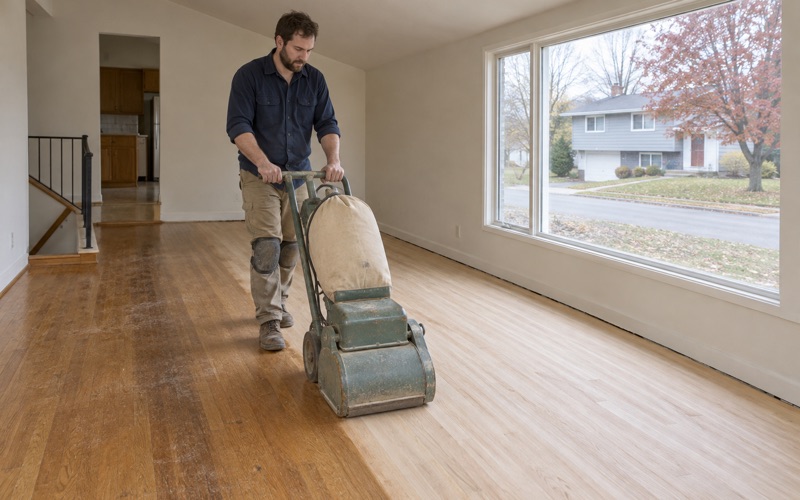
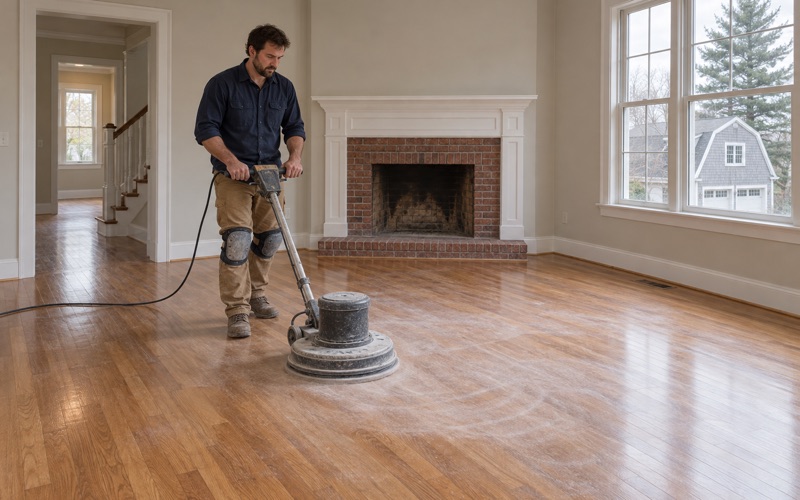
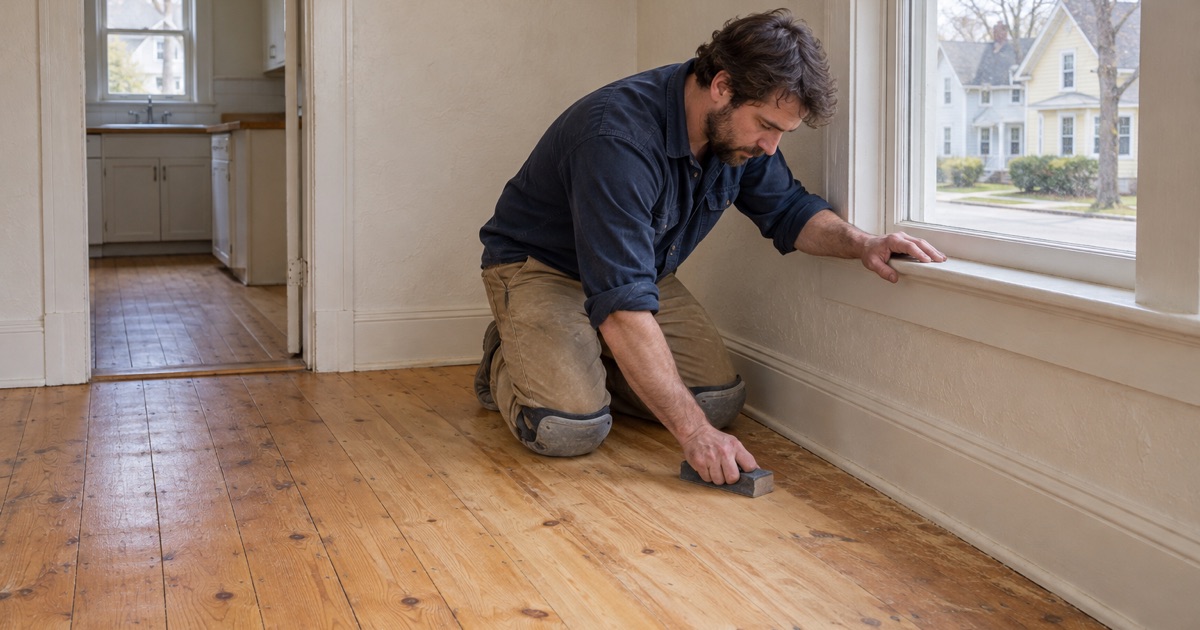
When a mill-house floor turns out to be softwood worth keeping, the refinish is gentler than one on oak. Pine gouges if a drum sander lingers, and it can lose a lot of thickness to an aggressive first cut. We choose the grit sequence for the wood we actually find, keep passes light, and switch to an orbital sander where the boards are worn thin or uneven. On boards that have been sanded before, we check the remaining thickness at a register or threshold before deciding how deep the first pass can go.
Lead Checks Before Sanding
Every house in the Presidential Village was built long before 1978, which puts it inside the Massachusetts Lead Law and the state’s own lead-safe renovation rules. Painted floors and painted baseboard are common in houses of this age. We confirm the build year and look at every painted surface in the work area before sanding starts, then plan containment and HEPA vacuum cleanup around what we find. If a floor or its trim turns out to carry lead paint, the work plan changes before any dust is made, not after.
Gaps, Cupping and Movement
Softwood floors in old houses usually show seasonal board gapping, since the wood swells in humid summers and shrinks when the heat runs in winter. Winter gaps that close again by summer are normal movement and should not be packed with rigid wood filler that will crack back out, and filling a gap that moves only pushes the stress into the next board. We fill only the gaps that stay open year-round and explain which ones will keep moving.
Where boards are cupping or crowning, we take moisture meter readings before sanding anything flat. A board that is cupped from moisture below will crown after sanding once it dries, so the cause has to be settled first. In a house of this age, the basement under the floor is the first place we check.
Finish Choices for Pine
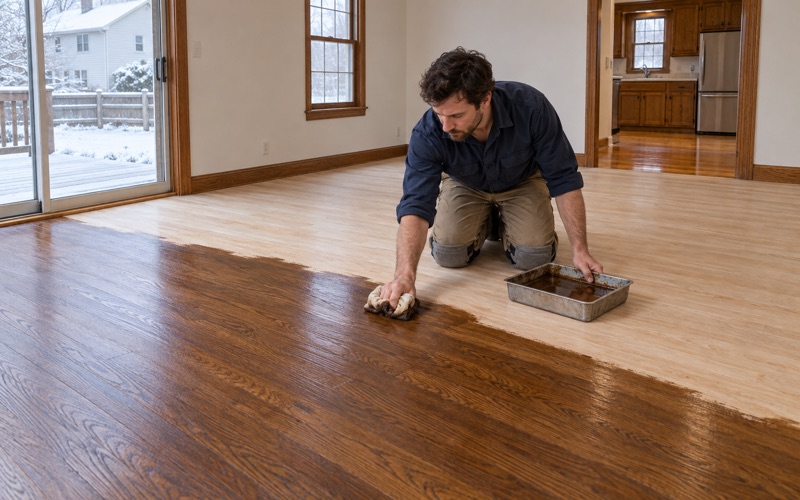
Pine takes stain unevenly and tends to blotch, so we lay stain samples on the actual floor rather than trusting a chip. Many owners prefer a clear finish that lets the wood deepen in tone on its own. We use waterborne polyurethane or hardwax oil chosen to meet the Massachusetts VOC limits for wood coatings, which are tighter than the federal rules, and match the sheen level to how hard the room is used.
A softer floor also rewards maintenance. A screen and recoat every few years adds protection without cutting into the wood, which matters on boards that have already been sanded several times. We tell owners plainly when a floor has enough thickness left for another full sanding and when a recoat is the smarter call.
Two-Family Homes in Maynard
The 1934 auction put 49 two-family dwellings into private hands alongside the single-family houses, and the two-family house remains part of Maynard’s housing today. The town counts 428 units in two-unit buildings, and 270 renter households live in them. Many of those buildings pair an owner on one floor with a tenant on the other.
Floors Between Tenants
For a landlord, floor work runs on the lease calendar. We turn floors around between tenants, sanding and recoating a unit while it sits empty so the next move-in date holds. Pet urine stains and water stains near kitchens and bathrooms are the usual findings after a long tenancy, and some boards need a weave-in repair rather than a sanding alone. Each unit gets its own schedule, so work downstairs does not have to wait on the tenant upstairs.
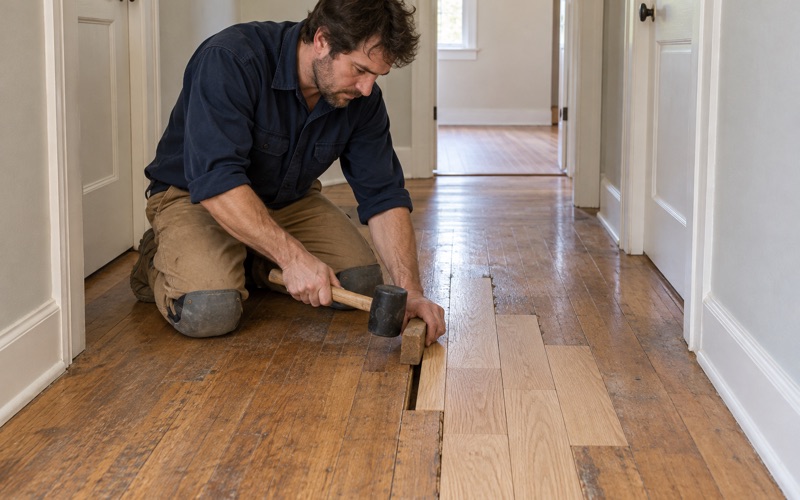
When a stain has gone black through the wood, sanding will not lift it. We cut out the affected boards and weave in replacements matched to the surrounding floor, then sand and finish the area together so the repair blends. On softwood that has been painted or covered for decades, a matching board sometimes has to come from a closet or another unseen corner of the house.
Stacked Units, Leaks and Shared Stairs
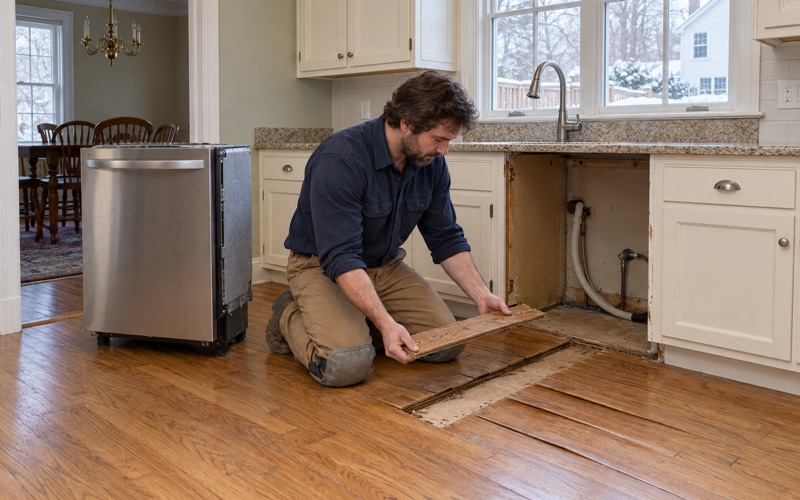
Two-family houses stack one kitchen over another, so a leak upstairs rarely stays upstairs. When a dishwasher, ice maker line or baseboard pipe lets go, we trace the source, dry the boards and read them with a moisture meter before replacing anything. For insurance claims we document the damage room by room so the adjuster sees exactly what was affected.
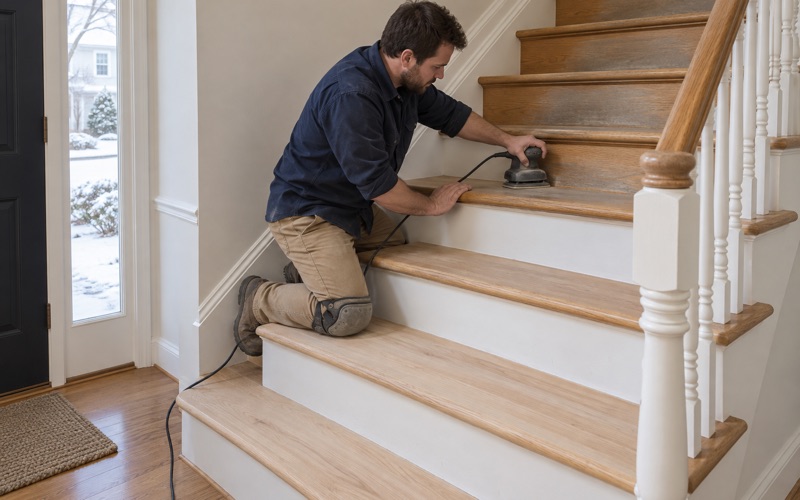
The shared stairs in these buildings take wear from two households. Worn nosings on older stairs can often be replaced on their own when the treads underneath are still sound. We quote stair treads, stair risers and stair nosing by the piece, not folded into a square-foot price, so an owner knows what the stairs cost on their own and can decide whether to do them now or at the next turnover.
Wood Floors Across Maynard’s Older Neighborhoods
The mill houses are only part of the picture. According to the American Community Survey, 1,683 of Maynard’s 4,956 housing units were built in 1939 or earlier, which is 34.0 percent of the town’s homes. Another large share went up in the 1960s, when 882 units were built, and construction since 2000 makes up a much smaller slice. Each period brought its own flooring habits, and each ages in its own way.
That spread shapes the floors we see. Pre-1940 houses may hold softwood, early strip oak or layers of both, while 1960s houses usually have red oak that has yellowed into the orange oak color many owners want gone. We take that orange tone to a natural or modern shade by testing color samples on the floor itself before committing a room.
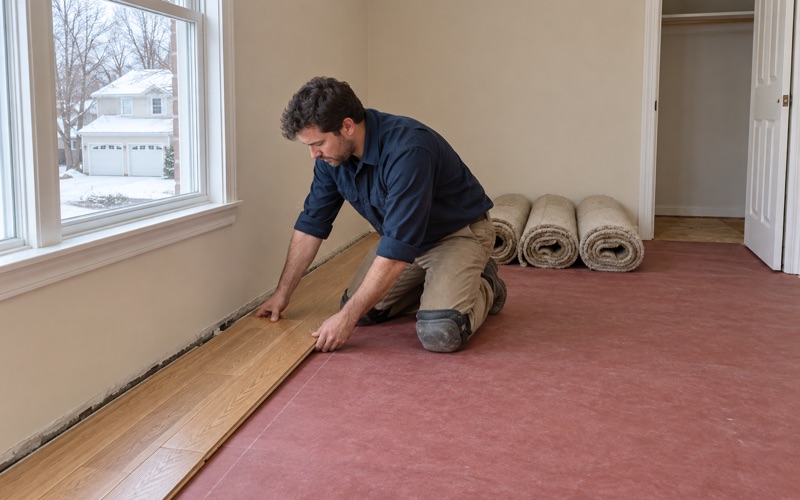
Houses from every era hide oak under carpet. When we pull it up, we remove the carpet pad, carpet staples and tack strip and clean out the holes before sanding, so the finish goes down over sound wood. That order keeps staples from tearing sandpaper and leaves the floor ready for a clean grit sequence.
Mill Town Texture
The mill complex that built the Presidential Village had a second life. Digital Equipment Corporation moved into part of it in 1957, bought the complex in 1974 and stayed until 1998, which earned Maynard the nickname ‘Mini Computer Capital of the World.’ The housing around the mill kept aging through both eras, and that housing is what we work on today.
Older Houses Without a Historic District
Owners of older houses sometimes ask whether floor work needs outside sign-off. Maynard currently has no local historic districts, and the Maynard Historical Commission works to preserve, protect and develop the town’s historic and archaeological assets. For questions about a particular project, the Town of Maynard building department is the office to ask.
Most Maynard homes are owner-occupied, about 75.0 percent of occupied units, which usually means floors are refinished for the long haul rather than patched for a sale. Whether the house is a Presidential Village mill house, a 1960s home or a newer build, we start with the same inspection and give you a plan built around what the floor actually is.
- 20+ Years on Wood Floors
- Free Written Estimates
- Lead-Safe Work Practices