Framingham Wood Flooring brings more than 20 years of wood-flooring work to Lexington, and the jobs we take on here now come in two shapes: owner-occupied houses where a family has lived on the same oak for decades, and a growing share of apartment units in buildings that did not exist a few years ago. The sanding, the finish and the repairs belong to the same trade in both. What changes is who decides, how fast the work has to turn, and what kind of floor is likely to be underneath.
In a house, we start with the build year and the boards themselves, and we check painted surfaces before a sander touches anything. In an apartment, we start with the owner or manager, the move-out date and whatever rules the building sets for noise, dust and working hours. We do not treat one as a smaller version of the other, because different people make the decisions that shape each job.
This page walks through both sides of that work in Lexington: what the town’s recent zoning decisions mean for floor projects, how rental units differ from owner houses, and how we plan a job so the floor you end up with fits the building it is in.
Wood Floors and Lexington’s Multifamily Pipeline

Lexington has spent the last few years deciding how many apartments it wants. Under its Village and Multi-Family Overlay zoning, about 1,100 multifamily units were proposed in two years, and the original article covered 227 acres across 12 districts that could potentially host up to 12,546 new dwelling units. For a town where most homes are detached houses, that was a large shift to weigh at once.
What the March 2025 Town Meeting vote kept
On March 17, 2025, Town Meeting scaled the overlay back from 227 acres to about 90, according to the Lexington Observer, and the article passed with about 94 percent support. The same motion allowed the ten projects already in the town’s pipeline to continue. Together those projects could bring approximately 1,100 new multifamily dwellings to Lexington.
For floor work, the vote matters less for its acreage than for what it left standing. The pipeline projects were not stopped, so the apartment side of Lexington’s housing is set to keep growing even inside the smaller zoning footprint. That is new ground for a town where apartments have been a small part of what gets built and renovated.
Militia Drive and Hartwell Avenue
The largest project we have seen named is 3-5 Militia Drive, which received major site plan review approval for two buildings with 292 dwelling units, 44 of them inclusionary units. A 130-unit rental project on Hartwell Avenue was approved by the Planning Board on April 17, 2025. Both sit inside the overlay framework the March vote narrowed but did not undo.
We are careful about what we say beyond that. We have not read the build status of either project, and nothing we have seen describes the floors or finishes planned inside them. So we will not tell you what those units will have underfoot. What we can describe is how we approach apartment floors in general, once any building in Lexington is lived in and its units start changing hands.
Apartment floors a few years in
Apartment floors, whatever the material, meet their first real test at the first turnover. Traffic lanes show from the entry to the kitchen, chair legs scuff a dining corner, and a slow ice maker line leak can leave water stains or cupping near the refrigerator.
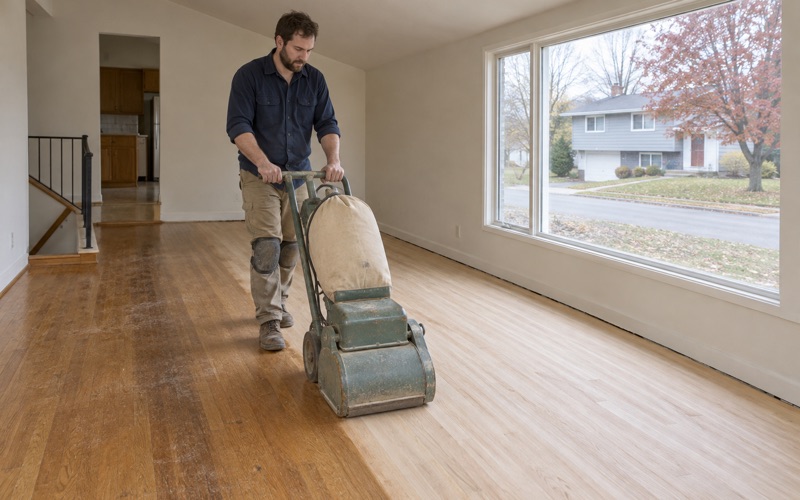
On a site-finished solid hardwood floor, a screen and recoat can often restore the surface without a full sanding. On an engineered floor, we measure the engineered wear layer before we promise any sanding, because a thin veneer over a plywood core cannot take the same cut a solid board can.
Looking for wood-flooring closer to Belmont? See Belmont Wood-Flooring.
Rental Units in Five-Plus-Unit Buildings
Apartments are still a small slice of Lexington’s housing. The ACS 2024 five-year estimates count 1,635 of the town’s 12,754 housing units, or 12.8 percent, in buildings of five or more units, and about 1,201 renter households live in those buildings. That is the baseline the pipeline projects are measured against.
Lexington overall is 80.5 percent owner-occupied, with 2,435 of its 12,477 occupied units rented. Renters live in every kind of building here, from detached houses to complexes of fifty or more units, but the five-plus group is where floor decisions most often belong to a landlord or property manager rather than to the person living on the floor.
Turning a unit between tenants
The gap between one lease and the next is usually short, and the floor has to fit inside it. We schedule rental work around the move-out date, walk the unit as soon as it is empty and tell the owner in writing which rooms need a screen and recoat, which need a full sanding and which have boards that should come out. Pet urine stains, water stains at a sink base and deep wear along a traffic lane are the usual findings, and each gets its own line in the quote.
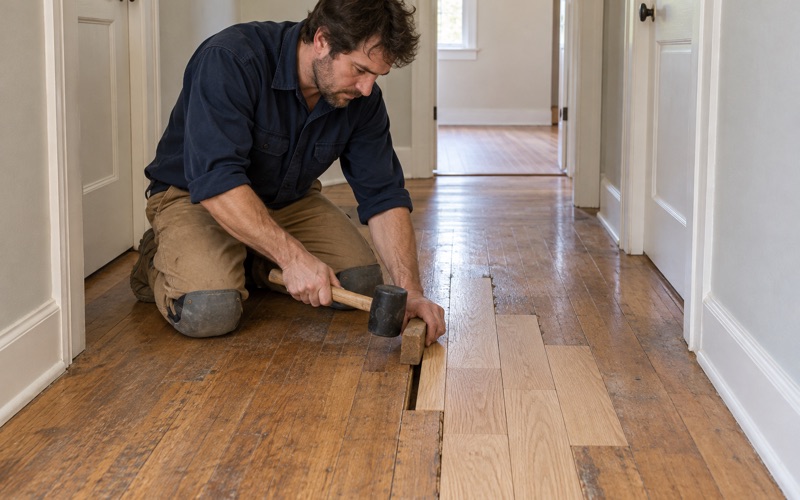
Landlords get the floor back ready for the next tenant, not ready for a second visit. When a board has to go, we do a weave-in repair so the new wood runs with the existing tongue and groove pattern instead of sitting as an obvious patch, then sand and finish the room so the repair blends with everything around it.
Shared walls, shared rules
Work in a multi-unit building also answers to the neighbors. Many buildings set quiet hours and rules for elevators, hallways and dust, and where a building is organized as a condominium under M.G.L. c.183A, the association’s documents can govern flooring changes. We ask for those rules before we quote, use dustless sanding with HEPA vacuum extraction in occupied buildings, and choose waterborne polyurethane where a lower odor matters to the units on either side.
Detached Houses Owned by the People Who Live in Them
Most of Lexington is still owner houses. Of the town’s 10,042 owner households, 8,705, or 86.7 percent, live in detached homes according to ACS table B25032. In those homes the person paying for the floor is the person living on it, which changes the job: the schedule bends around a household, and the choices are made for the long run.
Floors from several building eras
Lexington’s houses span a long stretch of building history. About 21.2 percent of units date from before 1940, 31.1 percent from 1950 through 1969, and 22.9 percent from 2000 or later. That range means we meet everything from older site-finished oak to prefinished planks put down in the last two decades, and we identify which one is in the room before we suggest a method.
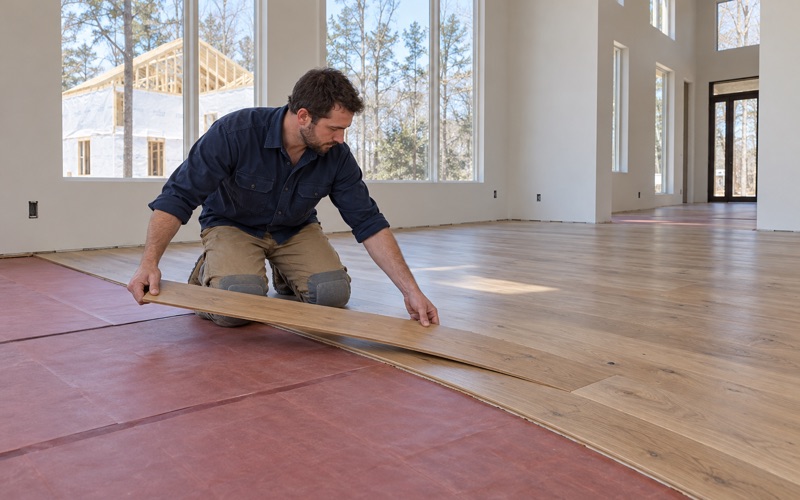
Red oak and white oak take stain differently, and a prefinished floor with a factory finish needs a different recoat plan than a floor finished in place. The town’s comprehensive plan also notes that historic homes, many dating to the early 1900s, have been demolished to make way for much larger ones. When a new house replaces an old one, the floors start from a clean subfloor, and species, width and finish are chosen fresh rather than matched to what was there.
Checking for lead before we sand
Most of the town’s housing, 64.7 percent, was built before 1980, which puts a large share of it near or before the 1978 line that Massachusetts lead rules draw. The state runs its own lead-safe renovation requirements under the Massachusetts Lead Law and 454 CMR 22.00, separate from the federal TSCA Title VI program. So we confirm the build year and check painted baseboards, stair risers and thresholds before sanding starts, and we plan the dust control around what we find.
Orange oak and carpet reveals
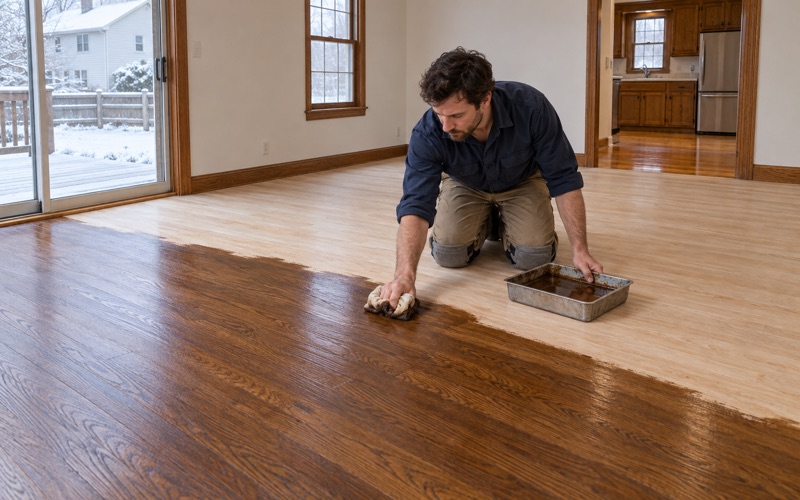
A common request in older owner houses is a refinish on oak that has turned orange or yellow under an old oil-modified polyurethane. We put color samples on the actual floor, in the room’s own light, before the homeowner picks a tone, whether that is a natural look or something cooler and more modern.
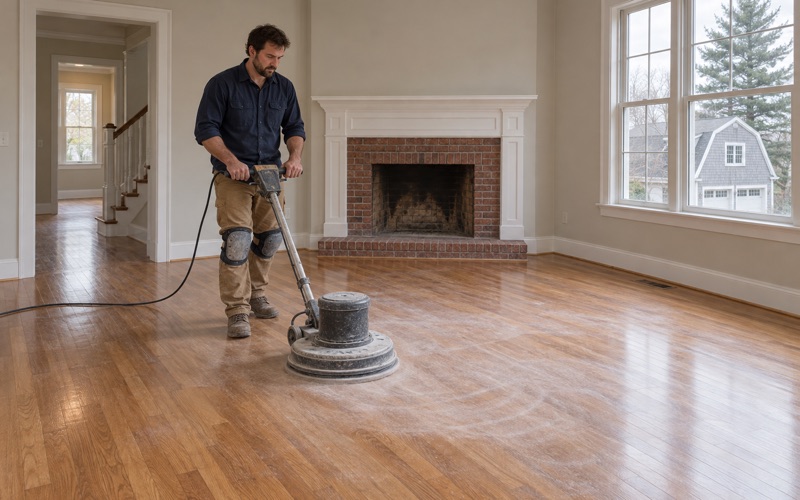
Where oak turns up under wall-to-wall carpet, we pull the carpet pad, carpet staples and tack strip and fill the holes before the drum sander runs, so the leftover debris is not ground into the grain.
Planning a Floor Project in Lexington
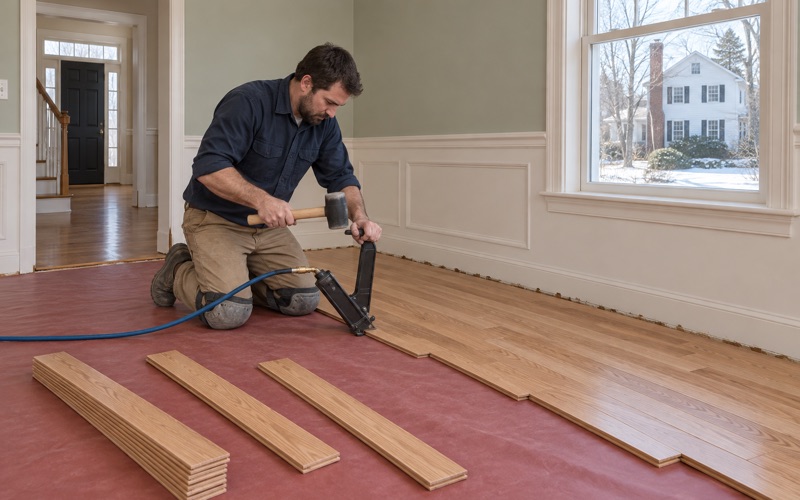
Lexington falls in National Weather Service forecast zone MAZ014, Southeast Middlesex. New England’s heating season dries indoor air, and wood floors answer with winter gaps between boards that often close again in the humid months. We take moisture meter readings and, for new installs, a relative humidity test in the room, and we let new boards acclimate before we lay them, so a floor installed in one season does not cup, crown or buckle in the next.
Who to ask about paperwork
Lexington is governed as a town, and the Town of Lexington Building Department is the office to ask about any filing a floor project might need; we do not answer that question from memory. In a rental or condominium building, the owner or association usually has its own approval step as well, and we build that into the schedule rather than discovering it on the first morning.
How we price and finish
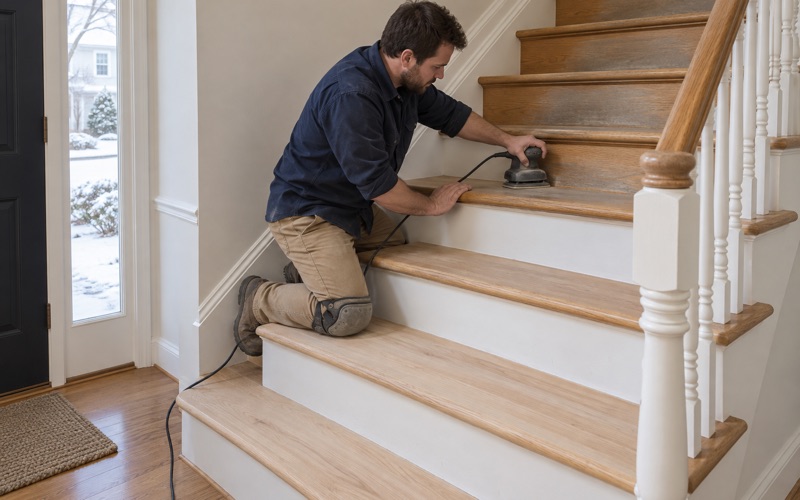
Stairs are priced by the tread and riser, with stair nosing called out separately, rather than folded into a square-foot rate. Finishes are chosen to fit the Massachusetts VOC limits for wood coatings under 310 CMR 7.25, which are tighter than the federal ones, and we go over sheen level and the choice between waterborne polyurethane, oil-modified polyurethane and hardwax oil before the first coat goes down.
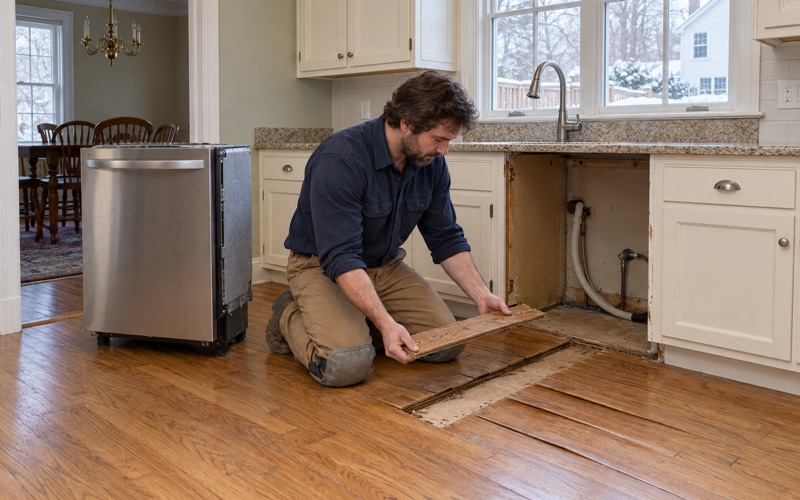
If a leak from a dishwasher or a hot-water baseboard pipe is behind the damage, we trace it, dry the boards and read them with a meter until they settle before replacing anything, and we document each room for the adjuster. Whether the floor is in a new apartment or a house a family has owned for decades, that order does not change.
- 20+ Years on Wood Floors
- Free Written Estimates
- Lead-Safe Work Practices