Framingham Wood Flooring has spent more than 20 years on wood-flooring in Hudson and the towns around it, from sanding worn oak in century-old houses to laying new boards in rooms that never had them. Our work covers refinishing, installation, repair and stairs, and every job starts with a look at the house itself rather than a price sheet. What a floor needs depends on when it went down and what has happened to it since.
That matters in Hudson, MA more than in most towns we serve, because the housing splits sharply between very old houses and a large mid-century wave. A floor with a century of wear and a floor that spent fifty years under wall-to-wall carpet call for different sanding plans, different fillers and often different finishes. We read the floor first, then recommend.
Before any sander touches a board, we confirm the build year and look for painted surfaces, since Massachusetts has its own lead-safe renovation rules for homes built before 1978. We also take moisture readings with a meter and check how the boards are fastened. The sections below cover what that looks like in Hudson specifically.
Floor Work Inside the Silas Felton Historic District
Downtown Hudson sits inside the Silas Felton local historic district, which covers the center of town along the Assabet River. The district’s rules identify about 65 downtown buildings as historically significant and set a guideline period of 1870 to 1955, the stretch in which most of today’s downtown took shape. Owners of those buildings often assume that any renovation, floors included, has to clear the commission first.
Much of that downtown went up after the July 4, 1894 fire, which burned 40 buildings and about five acres of central Hudson. What stands today largely reflects the decades that followed, when the shoe trade still drove the town’s economy. That history is what the district protects, and it protects it from the street.
What the Commission Reviews
The Silas Felton Hudson Historic District Commission is five residents appointed by the Select Board under Chapter 40C. Its Rules and Regulations, effective June 18, 2025, list the work that needs a Certificate of Appropriateness: signs, fences, exterior lights, walkways, doors, windows, siding, paint, roofing, porches, sheds, extensions and additions. Every item on that list is something a person standing outside the building can see.
The rules also except repairs that do not change a structure’s design appearance. For an owner planning inside work, the practical reading is that the commission’s list is about facades, rooflines and whatever faces the sidewalk. Nothing on it names floors, stairs or interior trim, and we do not read more into the local rules than they say.
Why Interior Floors Sit Outside Its Reach
The reason is state law rather than local preference. Massachusetts General Laws chapter 40C, section 7, keeps historic district commissions from reviewing interior features, so the boards inside a downtown storefront or an upstairs unit are not the commission’s business. When owners ask, that statute is the answer we point to.
That leaves owners free to choose finishes on practical grounds. A shop floor with steady foot traffic might get a durable waterborne polyurethane at a satin sheen level, while an upstairs living space could suit a hardwax oil that spot-repairs without a full recoat. Either way, the choice belongs to the owner and the floor, not to a review board.
Looking for wood-flooring closer to Dover? See Wood-Flooring in Dover.
Refinishing Pre-1940 Floors in a Shoe-Mill Town
From about 1850 until the last shoe factory burned in 1968, Hudson was a mill town built around shoes, with 17 shoe factories at its peak, many of them powered by the Assabet. The workers those factories drew from Canada and Europe needed housing, and a large share of it still stands. Census estimates count 2,070 of Hudson’s 8,858 housing units as built in 1939 or earlier, or 23.4 percent.
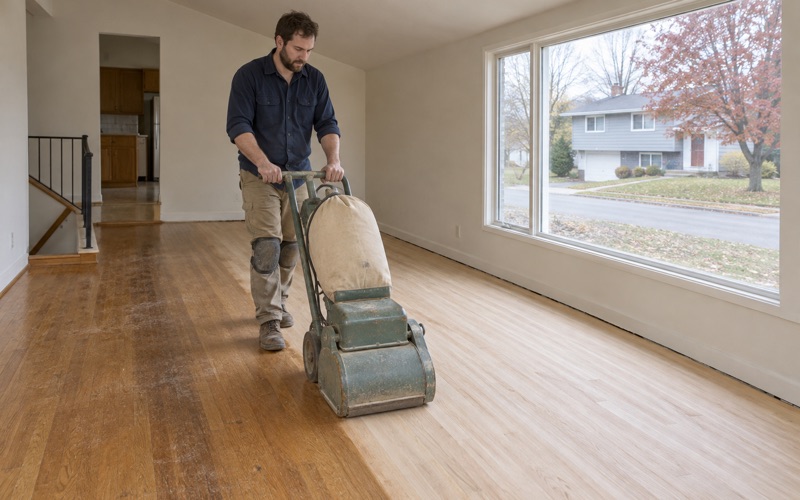
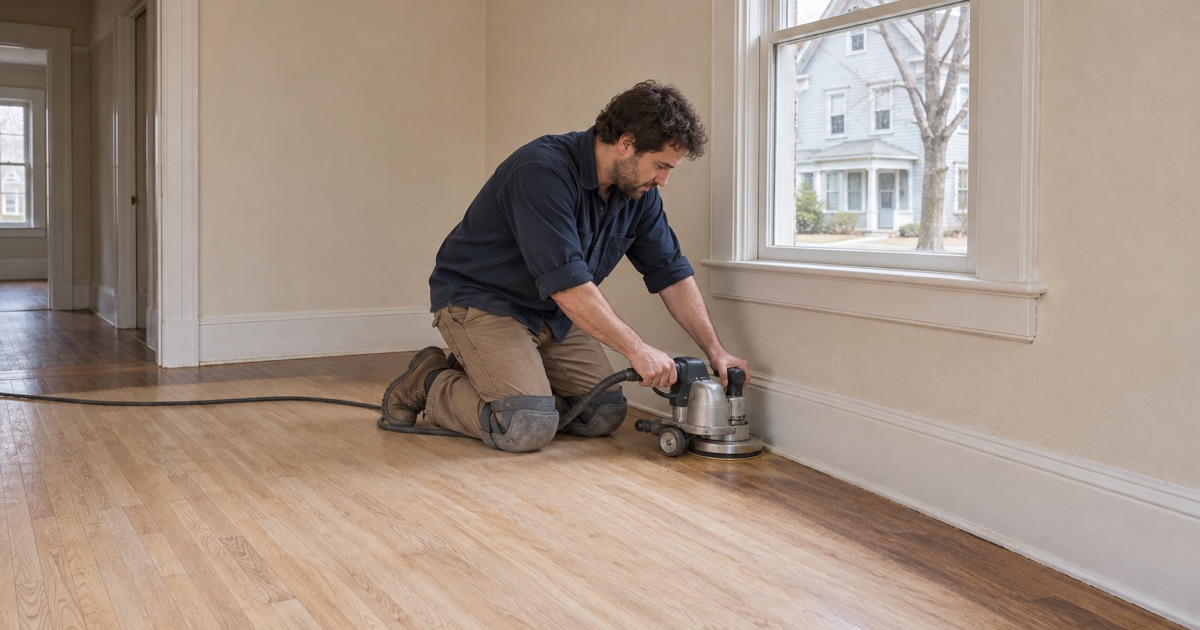
Floors in houses that old have usually been sanded more than once. Before we promise another full sanding, we check how much wood remains above the tongue and groove, because a board sanded too thin shows its fasteners and eventually splits along the groove. Where the margin is tight, a screen and recoat can refresh the finish without cutting into the wood at all.
Species and Wear Patterns
We identify the species on site rather than assuming it. An older Hudson house may hold red oak, white oak, maple or eastern white pine, and each sands differently. Pine has a low Janka hardness, soft enough that a drum sander can gouge it in seconds, so we often work it with an orbital sander and a gentler grit sequence.
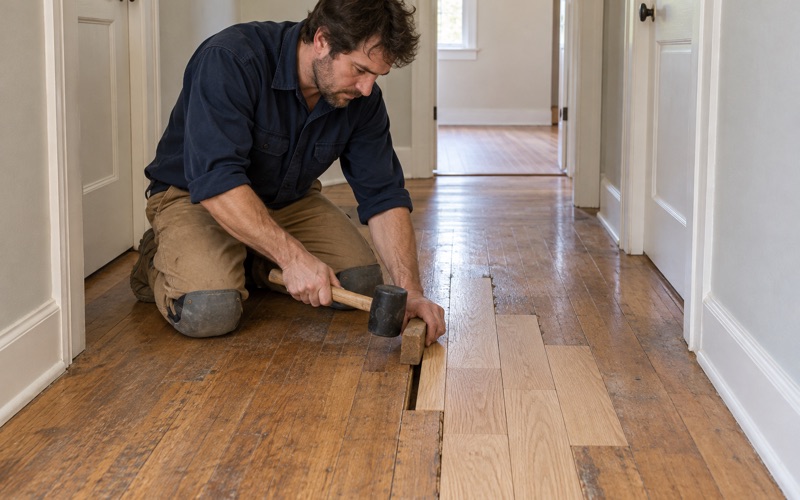
Traffic lanes worn into hallways, pet urine stains near back doors and water stains around old radiators are the patterns we see most. Dark urine stains often run deeper than sanding reaches, so we plan board replacement as a weave-in repair that staggers new boards into the old field instead of cutting a square patch that stands out.
Lead and Paint Checks
Every one of those pre-1940 houses predates 1978, so lead is part of the plan from the first visit. Painted borders, old stair risers and floor paint on back stairs are where we look first. We check the build year and any painted surfaces before sanding begins, rather than discovering them in the dust bag.
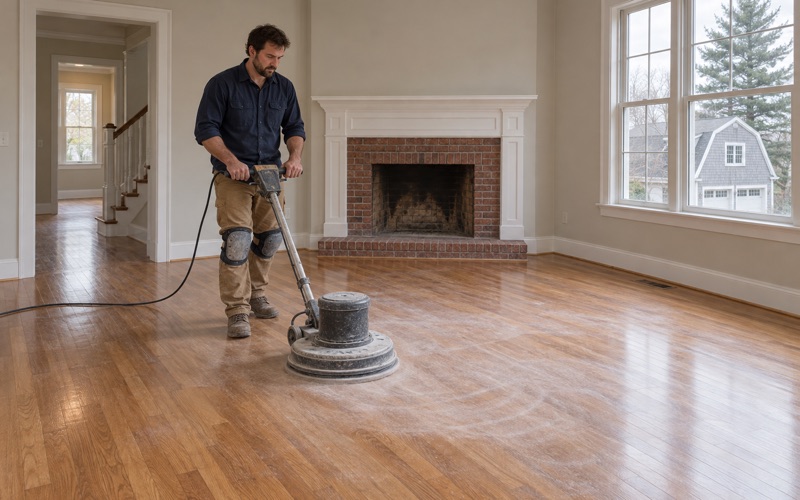
For the sanding itself we run dustless sanding with a HEPA vacuum connected to the machines, which keeps most fine dust out of the air and off the rest of the house. It is not a substitute for lead-safe practice, but it makes a real difference in older houses with plaster walls and layers of old trim.
Hudson’s 1960s Houses
Hudson’s second big housing wave came in the 1960s, when 1,649 units were built, the largest count for any single decade in the Census table for the town. Houses of that era commonly had oak strip floors that later disappeared under wall-to-wall carpet, and plenty of owners only find theirs when the carpet finally comes up.
Oak Under Old Carpet
When carpet comes up, the carpet pad, carpet staples and tack strip come with it, and each leaves a mark. We pull every staple, clean off pad residue and fill the tack-strip holes along the walls before any sanding starts. Sanding over a missed staple tears the paper and can scar the floor, so this step comes first, not afterward.
Once the floor is clean we look at board gapping, cupping and any signs of old water damage. Winter gaps that close again in summer are normal seasonal movement in a heated New England house and usually are not worth filling. Gaps that stay open year-round are a different matter, and we deal with those board by board.
Taking Orange Oak to a Newer Tone
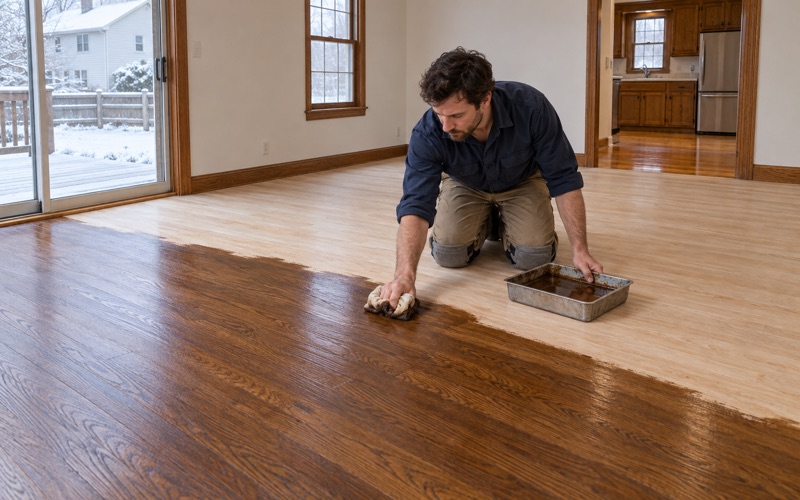
Oak finishes from decades back tend to amber, giving the floor the orange oak look many owners want gone. We take those floors to a natural or modern tone by laying stain samples on the actual boards before committing, since red oak and white oak take color differently. Water popping before staining opens the grain for a more even, deeper result.
For the finish, we match the product to how the room is used and to the Massachusetts VOC limits for wood coatings, which are stricter than the federal ones. A site-finished waterborne polyurethane stays clear and low-odor, while an oil-modified polyurethane adds warmth but ambers over time, which is how many of these floors turned orange in the first place.
Leaks, Stairs and Engineered Floors
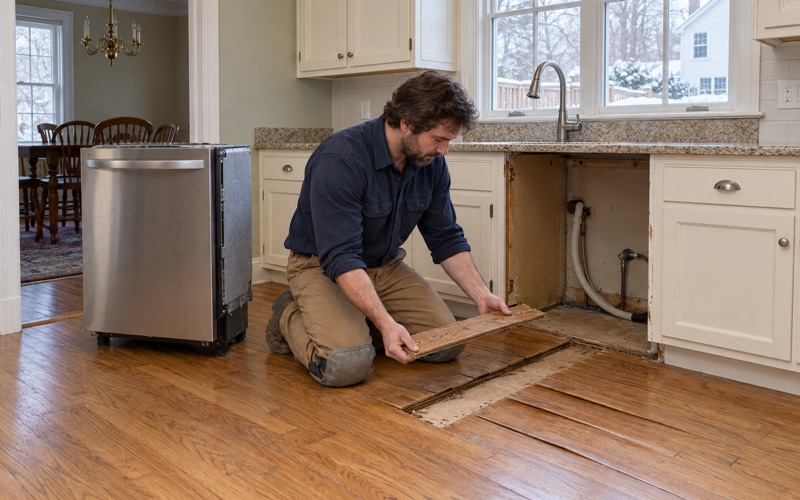
A kitchen that has gained a dishwasher or an ice maker line since it was built can hide a slow leak that cups the boards nearby. We trace the leak, dry the floor and read it with a moisture meter before replacing anything, and we document water-damaged floors room by room for the insurance adjuster.
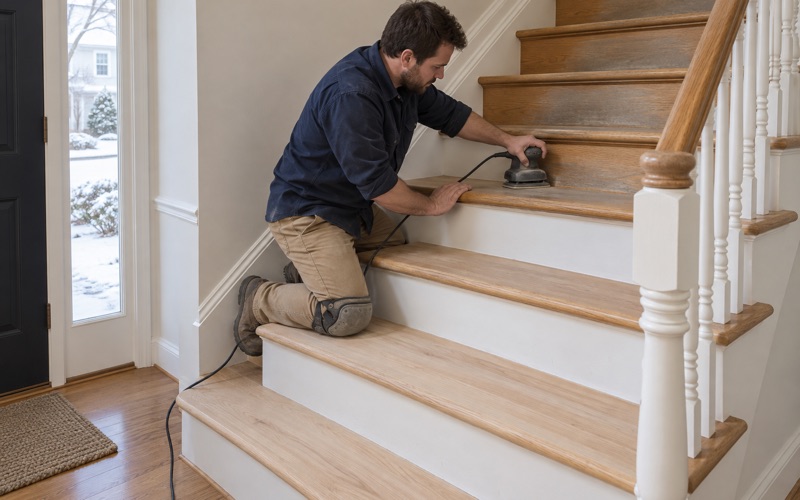
Stairs are quoted by the tread and riser, with the stair nosing handled on its own rather than folded into the square-foot price of the rooms. Where a later owner put down an engineered floor, we measure the engineered wear layer before promising a sanding, because some are too thin to sand even once.
Wood Floor Work Around Lake Boon, Gleasondale and Fort Meadow
Outside downtown, Hudson is a mostly suburban bedroom community. Gleasondale straddles the Hudson and Stow line, Lake Boon and White Pond sit on the Stow border, and Fort Meadow Reservoir lies on the Marlborough side. Housing in those areas spans a wide range of ages, and the floors inside it span just as wide a range of conditions.
Humidity and Seasonal Movement
Hudson falls in the National Weather Service’s Central Middlesex County forecast zone, and like the rest of the region it swings from humid summers to dry, heated winters. Wood follows that swing. Floors shrink and gap in January and swell in August, and a floor laid without an expansion gap at the walls can crown or even buckle when summer moisture arrives.
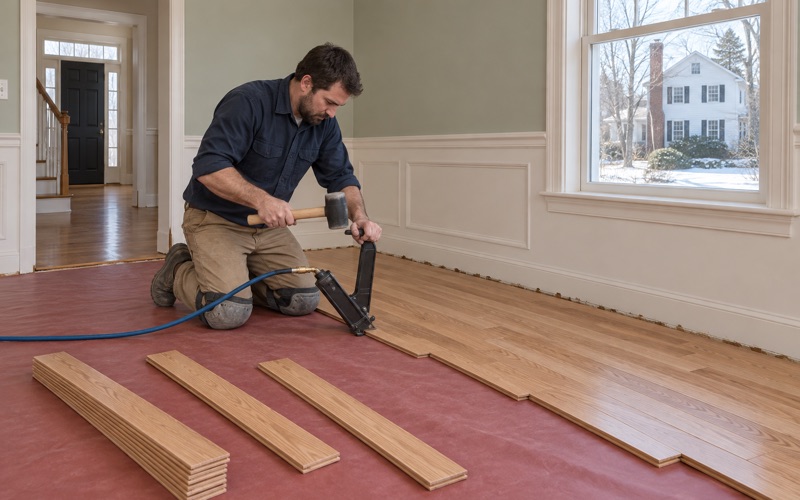
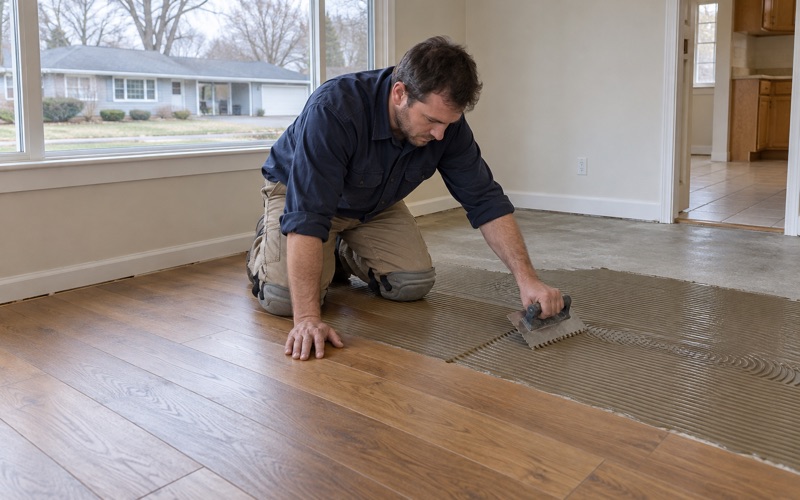
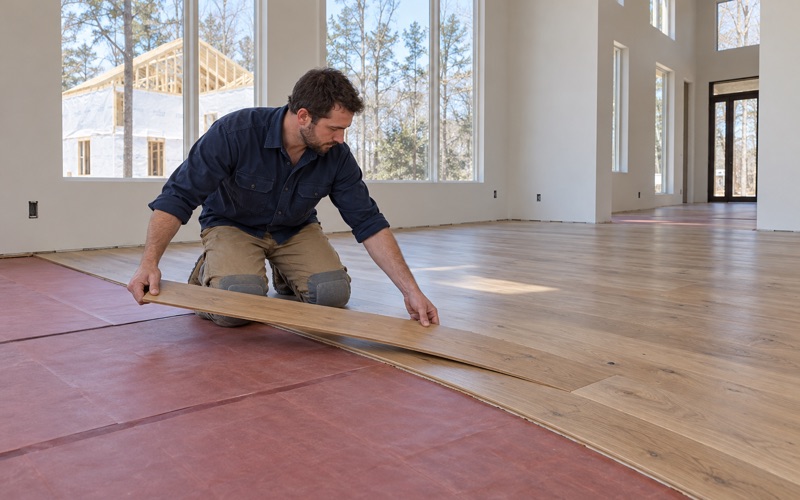
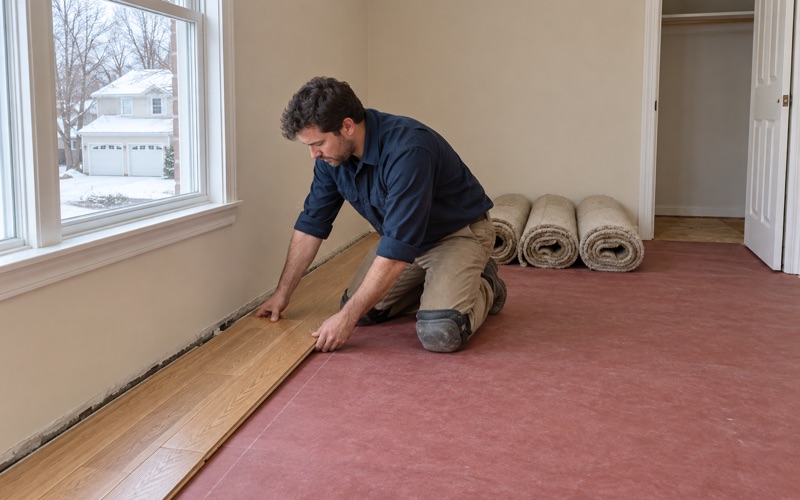
For new installations we deliver the wood early for acclimation and run a relative humidity test in the room before fastening anything. Solid hardwood goes down as a nail-down installation over a sound subfloor with flooring cleats, while a lower level with a concrete floor usually calls for an engineered floor with a plywood core, laid as a floating installation or glue-down installation over a vapor retarder.
Below-Grade Rooms and Insect Damage
Where a room sits partly below grade, walkouts included, we measure it against the NWFA Installation Guidelines before recommending any wood at all. Sometimes the answer is engineered flooring, and sometimes it is a different material entirely. We would rather say so up front than install a floor that cups within a season.
Older houses near wooded lots and open water can also show powderpost beetle holes or carpenter ant damage in boards near the sills. We check for both during the estimate, replace damaged boards with matching stock, and blend the repair into the surrounding floor so the patch reads as part of the room.
Whatever the age of the house, our Hudson estimates start the same way: build year, moisture readings, fastening and species, then a written plan for the floor. From there we refinish, repair, replace or install, and schedule the work around the household.
- 20+ Years on Wood Floors
- Free Written Estimates
- Lead-Safe Work Practices