
Framingham Wood Flooring handles hardwood floor repair in Framingham, MA, serving surrounding cities including Cochituate, Marlborough, Hopkinton, Wellesley and Maynard. After more than 20 years of fixing wood floors, we replace damaged boards, weave new wood into old floors, stop squeaks, remove stains and repair insect and moisture damage, then blend the repair into the floor so it stops being the first thing a visitor notices.
Most floors are worth repairing rather than replacing. A few bad boards in front of a dishwasher, a strip of bare subfloor where a wall came out, or a loose board by the back door does not mean the whole room has to go. The skill is in matching species, width and grade, and in knowing when a repair needs a refinish to finish it.
Before any repair, we find out why the damage happened. A board that cupped from a leak will cup again if the leak is still there, and a squeak caused by a sagging joist will return if only the board is nailed. Fixing the cause first is what makes the repair last.
Diagnosing the Damage
Cupping and Crowning Boards
Cupping is when the edges of each board rise above the center, and it almost always means moisture from below. Crowning is the opposite, with the centers higher, and it often shows up when a cupped floor was sanded flat before it had fully dried.
We read the boards and subfloor with a moisture meter before recommending anything. If the moisture source is fixed and the floor dries, mild cupping often settles by itself, and sanding too early turns a temporary problem into a permanent one.
Buckling and Lifted Floors
Buckling is when boards lift off the subfloor entirely, usually after a major leak or when a floor was installed without an expansion gap. It is the most severe form of moisture damage in wood floors.
Buckled areas usually need to be removed, the subfloor dried and inspected, and new boards installed. We check how far the moisture spread, because the damage visible on the surface is often smaller than the wet area below.
Board Gapping and Winter Gaps
Board gapping is common in winter, when heating dries the indoor air and the wood shrinks. These winter gaps usually close again in summer and are not a defect in the floor.
We look at whether gaps are seasonal or permanent before filling them. Permanent gaps in older floors can be filled with wood slivers, while seasonal ones are better managed with humidity control than with filler that cracks every spring.
Board Replacement and Weave-In Repairs
Replacing Individual Boards
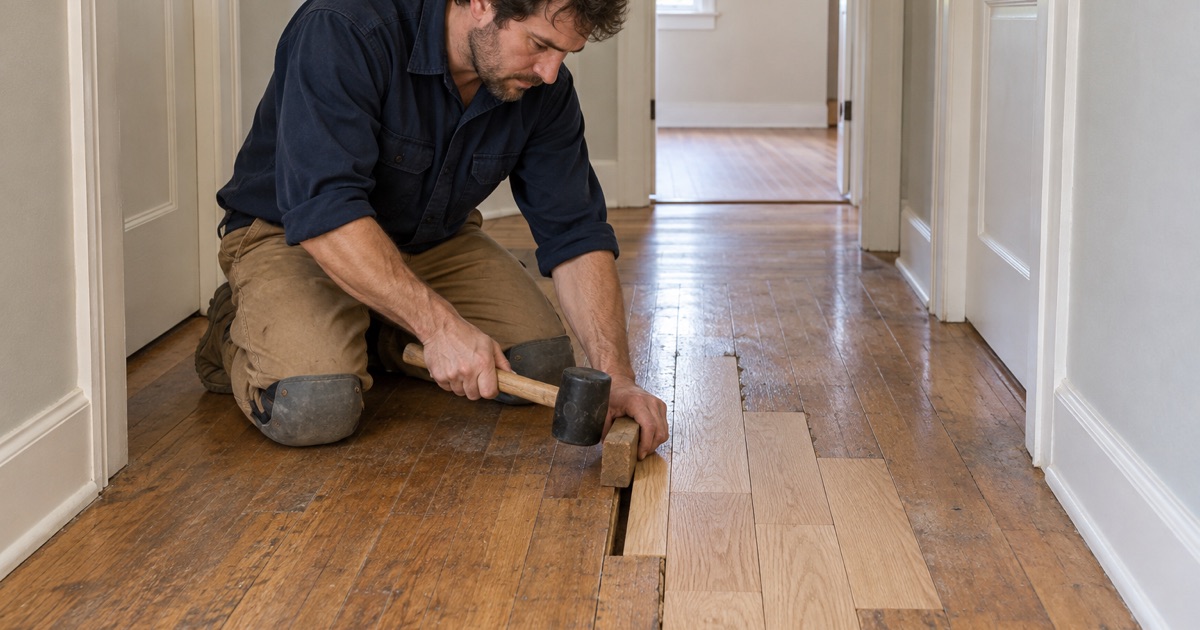
Board replacement means cutting out a damaged board down the center, removing the pieces without harming the boards beside it, and fitting a new board in its place. The replacement is glued and fastened so it sits flush and stays tight.
This is the repair we use most for isolated damage: a deep gouge, a burn mark, a board split by a dropped pan, or a few boards stained beyond sanding. Done carefully, only the color difference shows, and refinishing removes that.
Weaving In After a Wall Comes Out
When a wall between two rooms is removed, it leaves a strip of subfloor where the wall stood. A straight patch across that strip always shows, so we use a weave-in repair instead.
We remove boards at staggered lengths on both sides and weave new boards in so the joints overlap naturally. Once sanded and finished with the rest of the room, the old wall line disappears.
Matching Species, Width and Grade
A good repair starts with the right wood. Red oak, white oak and maple look different even before they are finished, and older floors may use widths that are no longer common.
We identify the species, measure the width and thickness, and match the grade so knots and color look consistent. For older floors, we sometimes reclaim boards from a closet to use in a more visible spot.
Squeaks, Loose Boards and Soft Spots
Squeaks and Backed-Out Cleats
Over decades, flooring cleats and nails can loosen as a house settles and the wood moves with the seasons. The boards then rub against the fasteners, causing squeaks with every step.
We locate the squeaks and refasten from above with small finish nails set into the joists, or from below where the basement ceiling is open. The goal is a quiet floor without visible repairs.
Loose Boards and Raised Edges
Some boards pop up at the ends or edges, especially near exterior doors and heating vents where moisture and temperature swing more. These raised edges can catch feet and wear quickly.
We reset the boards with adhesive and fasteners, and if the cause is moisture, we address that first. A loose board near a vent often signals a larger humidity swing in that room.
Soft Spots in the Subfloor
A spongy spot under a wood floor usually means the subfloor has weakened, often from a past leak near a bathroom, kitchen or radiator. Refastening the boards will not fix it.
We open the floor, cut out the damaged subfloor and replace it before relaying the wood. It is more work than a surface repair, but it is the only one that lasts.
Stains, Insects and Surface Damage
Pet Urine and Water Stains
Water stains often show as gray or white marks in the finish, and many sand out during a refinish. Pet urine stains are usually darker and go deep into the wood fibers.
We test-sand stained areas to see how deep they go. Boards with stains that remain are replaced before the refinish, so you are not left with dark patches under a new finish.
Powderpost Beetles and Carpenter Ants
Small round holes with fine, flour-like powder beside them usually mean powderpost beetles, which bore through hardwood. Carpenter ants leave coarser debris and tend to nest in damp wood.
We identify the likely cause and recommend a pest professional to treat it before we repair the floor. Replacing boards over an active infestation only moves the problem.
Gouges, Scratches and Dents
Furniture, pets and dropped objects leave scratches and dents. Light scratches in the finish can often be handled with a screen and recoat.
Deeper gouges that reach the wood may need wood filler, a sanding of the area, or board replacement. We match filler color to the finished floor so it blends rather than shows.
Repairs Before a Refinish, Sale or Tenancy
Repair First, Then Refinish
If a room will be refinished, all repairs happen first so the new boards are sanded and finished with the old ones. That is how the repaired area blends in completely.
Where a full refinish is not planned, we can often spot-finish the repair to a natural break such as a doorway or a change in board direction. We tell you honestly how close that will look before you choose it over a room-wide refinish.
Rental Turnovers
Framingham requires a rental unit inspection certificate before a new tenancy, and broken or damaged floors can hold it up. We schedule board repairs between tenants so the unit is ready for inspection.
For landlords with several units, we can walk each one at move-out, list what needs repair, and price the work unit by unit. That keeps floor repairs off the critical path when a new tenant is waiting for keys.
Older Homes and Painted Surfaces
In homes built before 1978, repairs that disturb painted trim, risers or old floor paint may fall under Massachusetts lead-safe renovation rules. We check the build year and plan the work accordingly.
Most board repairs in open floor areas never touch paint, but removing baseboard, shoe molding or a painted threshold can. Planning for that from the start keeps a small repair from turning into a cleanup problem.
- 20+ Years on Wood Floors
- Free Written Estimates
- Lead-Safe Work Practices