
Framingham Wood Flooring installs engineered hardwood flooring in Framingham, MA, serving surrounding cities including Cochituate, Marlborough, Hopkinton, Wellesley and Maynard. With more than 20 years on wood floors, we use engineered wood where solid hardwood would struggle: on concrete slabs, over radiant heat, in basements and in condos that need a quiet, stable floor.
Engineered flooring is real hardwood on top of a stable core, and it comes in a wide range of quality. The thickness of that top wood layer, the build of the core and the finish all decide how long the floor lasts and whether it can ever be sanded. We explain those differences in plain terms so you can compare products on more than price and color.
In this area it is often the only practical way to put wood on a slab ranch, where heating coils run through the concrete and nailing is not an option. It also makes sense in walkout basements that pass a moisture test, and in upper-floor condos where the association wants sound underlayment beneath the boards.
How Engineered Hardwood Is Built
The Engineered Wear Layer
The wear layer is the slice of real hardwood on top, and it is the only part of the board that can be sanded. Thin veneers look identical to thick ones on the day they are installed, which is why product comparisons that stop at color miss the most important number.
A thicker wear layer allows the floor to be sanded and refinished later, possibly more than once. A thin one can only be screened and recoated, so its life ends when the top finish and wood are worn through.
The Plywood Core and Other Cores
Beneath the wear layer, most quality engineered boards use a plywood core with layers running in alternating directions. That cross-grain build is what keeps the board from swelling and shrinking as much as solid wood.
Some products use fiberboard or other composite cores, which can be flatter but tolerate moisture differently. We match the core type to the room and installation method rather than treating all engineered boards as the same product.
Prefinished Surfaces and Plank Widths
Most engineered floors are prefinished, so they arrive with a factory coating and can be walked on right after installation. The edges may be square or slightly beveled, which changes how the seams look.
Engineered construction also makes wide planks more practical, since a wide solid board moves more with the seasons. Wide plank white oak in an engineered build keeps the look with less seasonal gapping.
Choosing an Engineered Product
Species and Grade on the Top Layer
Engineered floors come in the same species as solid ones, most often white oak, red oak, maple and hickory. The species decides color and hardness, and the Janka hardness figure for the face wood is a fair guide to how the surface will handle dogs and chairs.
Grade still matters too. A select grade face shows a calm, even surface, while a character grade face carries knots and color variation that hide dents and scratches in a busy family room.
Factory Finish Types
Most prefinished engineered boards carry a factory urethane with hard mineral particles mixed in, which resists wear well but can be difficult to recoat. Others use an oil or hardwax oil finish that looks softer and can be refreshed in small areas.
We ask how you live on the floor before recommending one. A kitchen with a large dog needs different protection than a bedroom, and the finish choice affects how easily the floor can be maintained over the years.
Reading the Product Specifications
The specification sheet tells you what the showroom sample does not: wear layer thickness, core type, whether the product is approved for radiant heat and below-grade rooms, and which installation methods keep the warranty valid.
We read those details with you before ordering. A floor installed against the manufacturer’s conditions can lose its warranty on the first day, even if it looks perfect when the work is done.
Where Engineered Wood Fits Best
Concrete Slabs and Radiant Heat
Thousands of Framingham ranches sit on concrete slabs, many with heating coils in the concrete. Solid oak cannot be nailed there, and even if it could, the heat would dry and shrink it badly each winter.
Engineered flooring rated for radiant heat handles that assembly far better. We test the slab first, follow the manufacturer’s radiant instructions, and make sure the surface temperature stays within its limit.
Basements and Walkouts Below Grade
Any floor on a basement slab is below grade, where moisture from the ground moves up through the concrete. The NWFA guidelines set out how wood can be installed there, and the manufacturer adds its own conditions.
We measure moisture in the slab and the room, check walkouts as carefully as full basements, and recommend a vapor retarder and installation system that suit the readings. If the space is too damp, we say so rather than install a floor that will cup.
Condos and Sound Underlayment
Many condo associations in Massachusetts set flooring rules in their by-laws, often requiring an acoustic underlayment or approval before hard flooring goes in. Engineered wood works well over those underlayments.
We review the association’s rules and supply product and underlayment specifications for approval. Getting that approval before installation avoids having to remove a finished floor later.
Installing Engineered Flooring
Glue-Down Installation
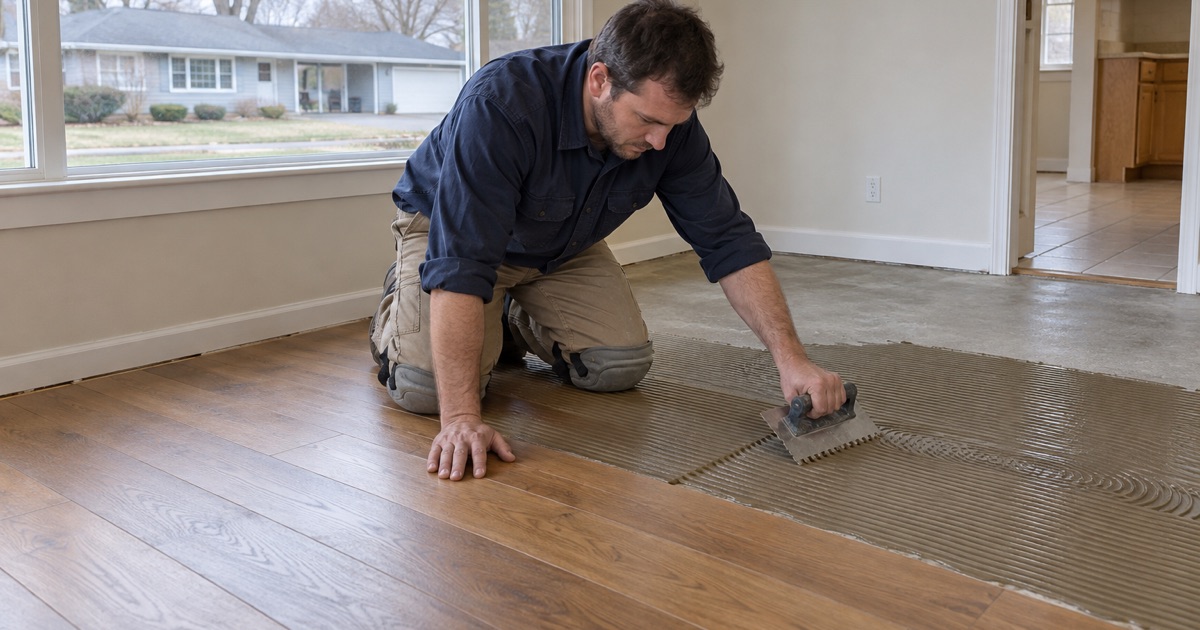
Glue-down installation bonds each board to a prepared concrete slab or wood subfloor. The concrete is ground flat, cleaned and tested, and the adhesive is chosen to suit the product, the slab and any radiant heat.
The result feels solid underfoot and sounds like a nailed floor. It is the method we use most on slab ranches where the flooring must stay tight over years of heating seasons.
Floating Installation
A floating installation clicks or glues boards to each other over an underlayment without fastening them down. It is quicker, works over many existing surfaces, and allows the whole floor to move as one piece.
Floating floors need an expansion gap at every wall and cannot have heavy cabinets or islands pinning them. We plan transitions so the floor moves freely and does not open gaps in doorways.
Nail-Down or Staple-Down Over Plywood
Over a plywood subfloor above grade, many engineered floors can be nailed or stapled like solid hardwood. That method gives a firm feel and suits upper floors in older houses.
We use the fastener type and spacing the manufacturer requires. Using the wrong staples or spacing can split thin edges or void the product warranty.
Caring For and Refinishing Engineered Floors
Measuring the Wear Layer Before Sanding
Before we promise a full sanding on an existing engineered floor, we measure the wear layer at a floor register, threshold or removed board. If there is enough, the floor can be sanded like solid wood.
If the wear layer is thin, sanding would cut through to the core and ruin the board. In that case we recommend a screen and recoat or, if the floor is too worn, replacement.
Screen and Recoat for Engineered Floors
A screen and recoat lightly abrades the existing finish and adds a fresh coat without cutting into the wood. It is the safest way to refresh a thin engineered floor.
Some factory finishes resist new coatings, so we test adhesion in a closet first. Recoating a finish that will not bond leads to peeling, and a test patch catches it early.
Replacing Damaged Boards
A gouged or water-damaged engineered board can usually be cut out and replaced without disturbing the rest of the floor. We try to source a match from the original product line, and where that product is discontinued, we look for a close match and place replacement boards where they blend in best.
- 20+ Years on Wood Floors
- Free Written Estimates
- Lead-Safe Work Practices