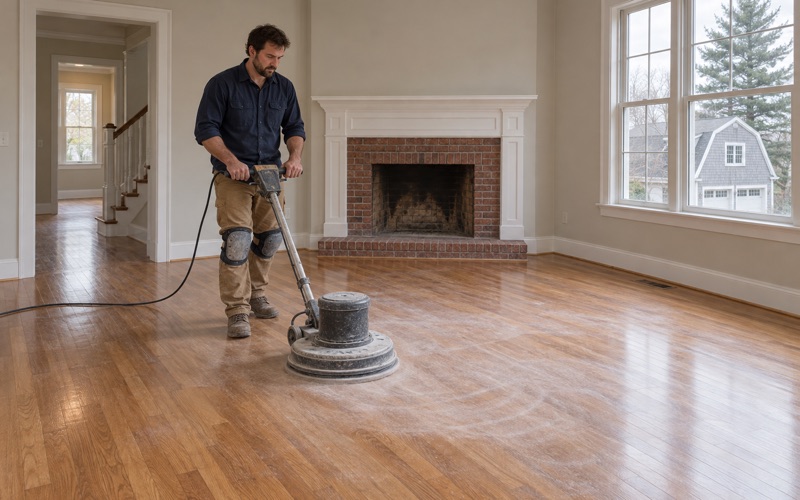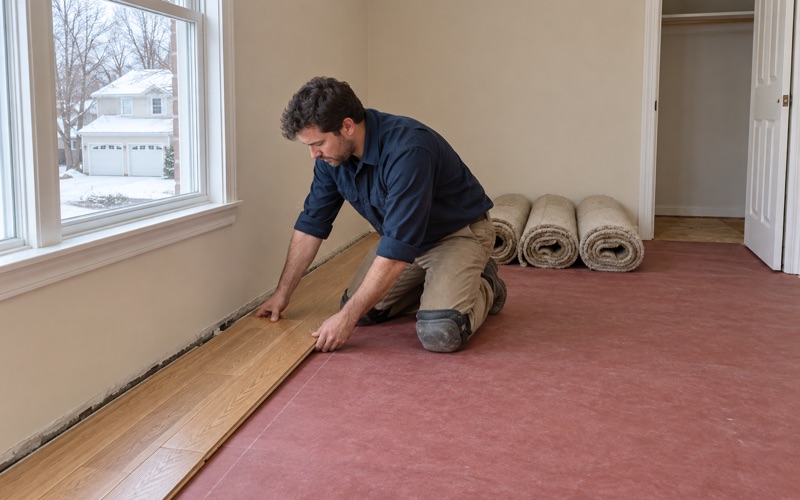
Framingham Wood Flooring takes on wood flooring in Bellingham with more than 20 years spent refinishing and repairing floors that have already had a long working life. The floors we meet in older houses are rarely blank slates. They have been sanded before, sometimes covered over, and walked in the same few paths for decades, and every one of those chapters shows up once the finish comes off.
That history decides the job. A floor with plenty of wood left above the tongue can take a full sanding and a new finish, while a floor thinned by earlier refinishes may be better served by a screen and recoat, a few board replacements, or a weave-in repair. We measure and test before we quote, so the plan fits the floor you actually have rather than the one a price sheet assumes.
Each visit starts with the same questions: when the house was built, what finish is on the floor now, where the wear is heaviest, and whether painted trim or thresholds sit inside the work area. From there we walk you through what the floor can handle, what the work will cost, and how long your rooms will be out of use while it is done.
Wood Floors in Bellingham’s Mid-Century Houses
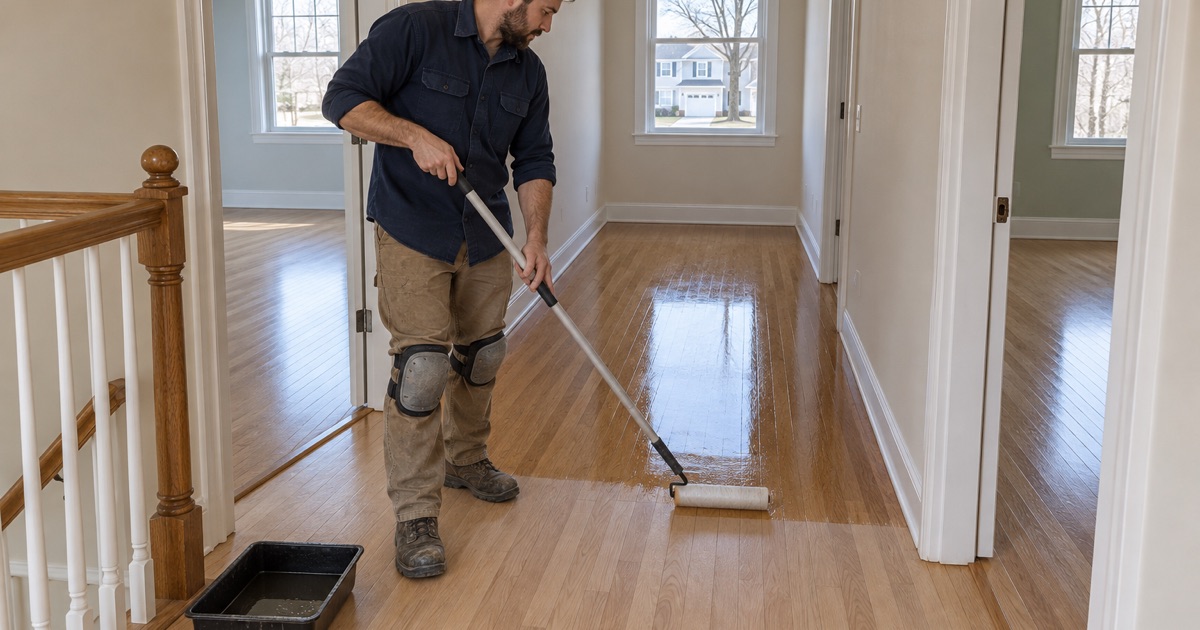
Bellingham’s housing leans heavily toward the middle of the last century. In the Census Bureau’s American Community Survey 2024 five-year estimates, the 1960s are the town’s largest build decade, with 1,333 housing units, and 47.3 percent of all units date from 1950 through 1979. That puts a large share of the town’s wood floors somewhere between 50 and 75 years old, which is the age when a floor’s past work starts to matter as much as its current condition.
Owner-occupied, single-family floors
The same survey counts 78.9 percent of occupied units as owner-occupied, and 87.3 percent of owner households live in detached houses. For floor work, that shapes the decision. A floor in a house its owner plans to keep is usually worth restoring rather than replacing, and the choices made now, like the stain color, the sheen level and the finish type, are ones you will live with for years.
Detached houses also tend to have floors that run continuously through several rooms. When a living room, hallway and bedroom share one field of boards, we plan the sanding and finish as a single job so the rooms match, rather than refinishing one space and leaving a visible line at a doorway or reducer.
What 50 to 75 years leaves behind
Floors of this age commonly show traffic lanes worn down the middle of a hallway, gray water stains near exterior doors and radiators, board gapping that opens every winter, and pet urine stains that have soaked into the grain. Red oak finished decades ago in amber-toned coatings has often aged into the orange oak many owners want gone.
None of those problems means the floor is finished. Winter gaps that close again in summer are normal seasonal movement, not failure. Traffic lanes and orange tones usually sand out cleanly. Deep pet stains and cupped boards near an old leak are the cases where board replacement becomes part of the plan.
Checking the build year before sanding
Houses built in the 1950s, the 1960s and most of the 1970s predate 1978, and Massachusetts runs its own lead-safe renovation rules for homes built before then, under 454 CMR 22.00 and the Massachusetts Lead Law. Before the drum sander comes out, we confirm the build year and check the painted baseboard, quarter round and thresholds the work will disturb. That way the job is set up correctly from the first day instead of being corrected halfway through.
Looking for wood-flooring closer to Clinton? See Wood-Flooring in Clinton.
How Many More Sandings an Older Floor Can Take
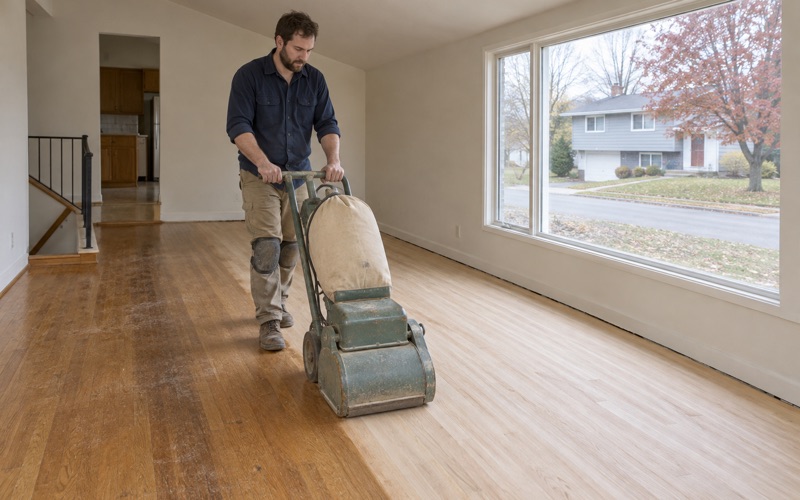
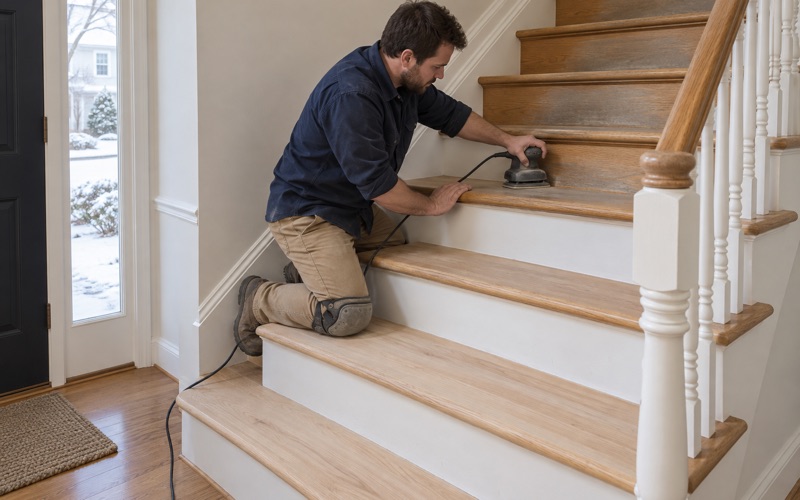
A solid hardwood floor can only be sanded so many times. Each full sanding removes wood from the top of the board, and on a standard three-quarter-inch tongue and groove floor the usable wood sits above the tongue. Once sanding gets too close to that tongue, boards start to splinter along their edges and can no longer be refinished.
A floor laid in the 1960s may already have had two or three full refinishes, sometimes with a rented drum sander that took more wood than the job needed. That is why we never promise a sanding before we have looked closely at the boards themselves.
Reading the remaining wood
Where we can, we pull a floor register, a threshold or a length of quarter round to see a board’s edge in profile. We also look for signs of thinning on the surface: exposed tongues along seams, fasteners sitting close to the top, and dished areas where an earlier sander lingered too long. Those observations tell us whether a full pass through the grit sequence is safe or whether the floor calls for a lighter touch.
When a screen and recoat is the better call
If the finish is worn but the wood beneath it is sound, a screen and recoat restores protection without removing any wood at all. We abrade the existing finish with a buffer, clean the room with a HEPA vacuum and apply fresh coats of waterborne polyurethane or oil-modified polyurethane. On a floor with only a sanding or two left, saving one of them for later is worth a great deal.
A recoat will not remove deep scratches, water stains or orange oak, though. When those are the real complaints, we lay out the trade-off plainly: a full sanding fixes more, but it spends some of the floor’s remaining life to do it.
Engineered floors added later
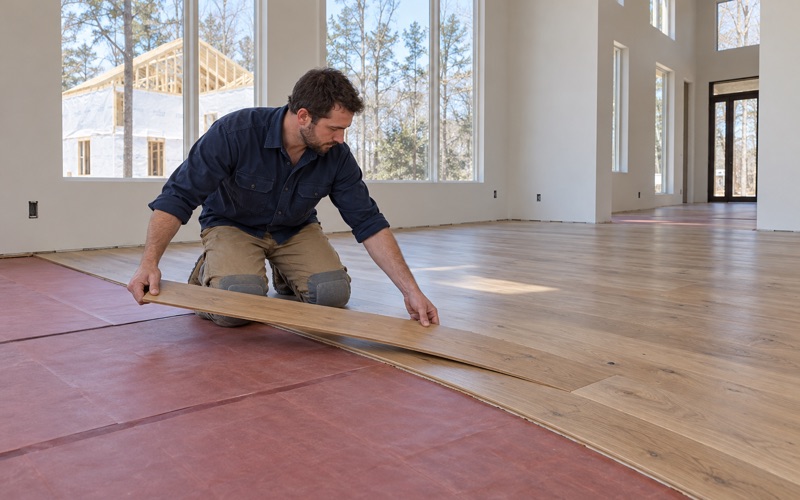
Some older houses have had an addition or a kitchen redone with engineered flooring at some point. The wear layer on an engineered board can be thick enough for one or more sandings, or too thin for any. We measure the engineered wear layer before a sanding is promised, because sanding through it exposes the plywood core and cannot be undone.
Uncovering Old Floors and Repairing Worn Boards
Wall-to-wall carpet and sheet vinyl went down over plenty of wood floors in later decades. Whether a particular Bellingham house has hardwood under its carpet is something only a look can confirm; some do, some have a plywood subfloor, and some change from room to room. We lift a corner in a closet or along a baseboard before anyone commits to a plan or a budget.
Cleaning up before sanding
When we do find oak under carpet, the carpet pad, carpet staples and tack strip come out before any sanding begins, not after. Old pad can bond to the finish, and staples left behind tear abrasive and gouge the boards. The small holes the tack strip leaves along the walls are filled with wood filler matched to the species.
Floors that spent years under carpet are often in better shape than the exposed ones, because they missed decades of foot traffic. They can still carry surprises, such as pet urine stains that soaked through the pad, old water stains, or a patched section where a wall once stood. We tell you what we find before sanding starts, so nothing on the invoice comes as news.
Hallway and entry board repair
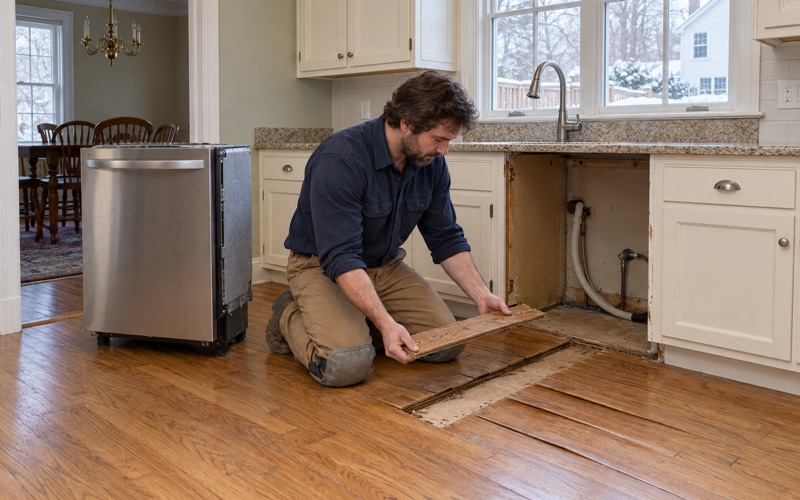
Hallways and entries take the most concentrated wear in a house, and in a floor this old they usually show it first. Boards at the front and back doors can turn dark at their edges from water tracked in over the years. A hallway can wear through its finish in a clear lane while the edges along the baseboard still look nearly new.
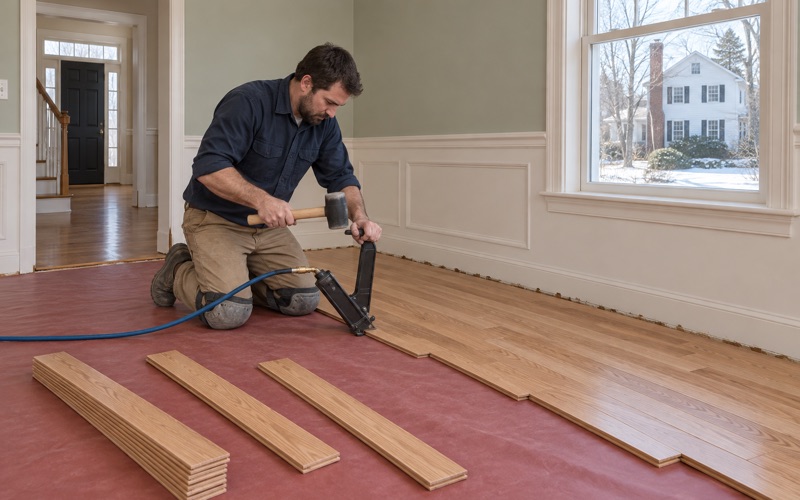
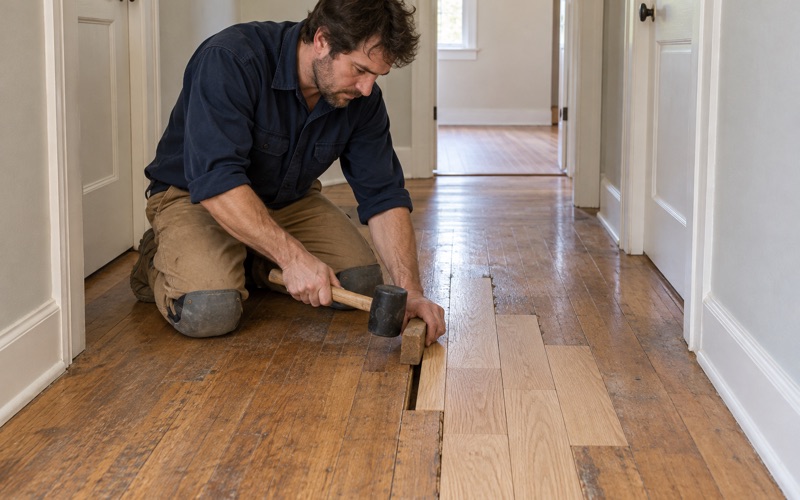
For damaged boards we do a weave-in repair: the worn or stained boards are cut out and new solid hardwood is laced into the existing pattern, with the joints staggered so the repair does not read as a patch. We match species and grade, commonly red oak or white oak in houses of this era, and then sand the repaired area with the surrounding floor so it takes the same finish.
If a damaged area sits near a dishwasher, an ice maker line or a hot-water baseboard pipe, we trace the leak first and read the boards with a moisture meter. Replacing wet boards over a live leak only means paying for the same repair twice.
Older Floors in Caryville and the Village Centers
Not all of Bellingham is mid-century. The same census estimates count 803 units, 12.0 percent of the town’s housing, built in 1939 or earlier. The town’s older village areas include North Bellingham, South Bellingham and Caryville, the former mill village in the northeast corner that grew from the Caryville Mill, opened in 1813 by Joseph Fairbanks.
Working on the older minority
A house built before 1940 can hold floors that behave differently from the mid-century oak around it. It may have wider boards, softwood like eastern white pine, face-nailed boards, or several generations of patches left by earlier owners. Those floors call for a gentler approach: an orbital sander in place of an aggressive drum pass, close attention to cupping and crowning, and a finish chosen to suit softer wood.
Pine in particular dents and marks more easily than oak, with a much lower Janka hardness. We talk that through with owners before choosing between a hardwax oil, which is easy to spot-repair, and a harder polyurethane film that resists wear but shows repairs more.
Finishes and seasonal movement
Wherever the house sits in town, we choose finishes that fit the Massachusetts VOC limits for wood coatings, which are stricter than the federal ones. Bellingham falls in the National Weather Service forecast zone for Western Norfolk, and like the rest of the region its floors move with the seasons. Dry indoor air during heating season opens gaps and humid summers close them, so we acclimate new boards and time finishing work around that swing.
Color on the actual floor
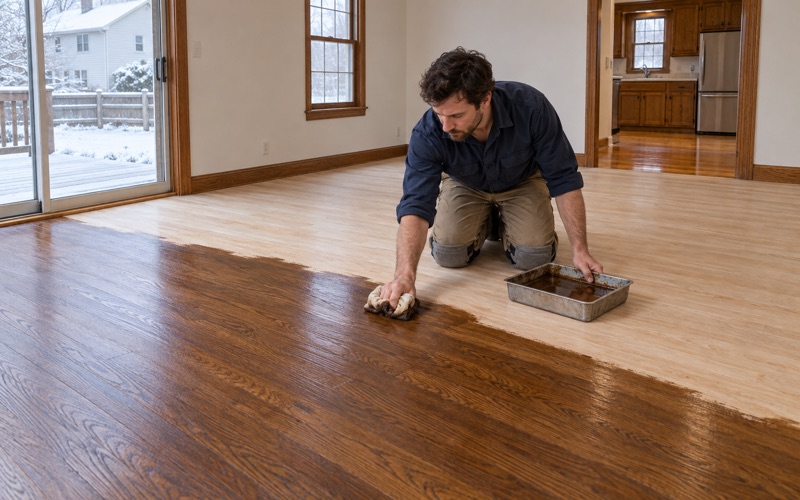
For owners ready to move past orange oak or a dated stain, we lay stain samples directly on the sanded floor, often after water popping to show how the grain will take color. You choose from real boards in your own light, not from a printed chart under store lighting.
Whether your house sits near the I-495 interchange at Exit 46 on Hartford Avenue or on a quiet street in one of the older villages, the first step is the same. We walk the rooms, look closely at the wood, and give you a clear plan for what your floor can still take.
- 20+ Years on Wood Floors
- Free Written Estimates
- Lead-Safe Work Practices